
Baseboard heater installation
Need a baseboard heater installed, replaced, or removed? The Wire Guys handles electric baseboard heaters and wall thermostats for homeowners across British Columbia. For new heaters, basement upgrades, or larger units, we check the electrical load first to make sure your panel can safely handle the added demand.
4.7 from 137 Google reviews Read them on Google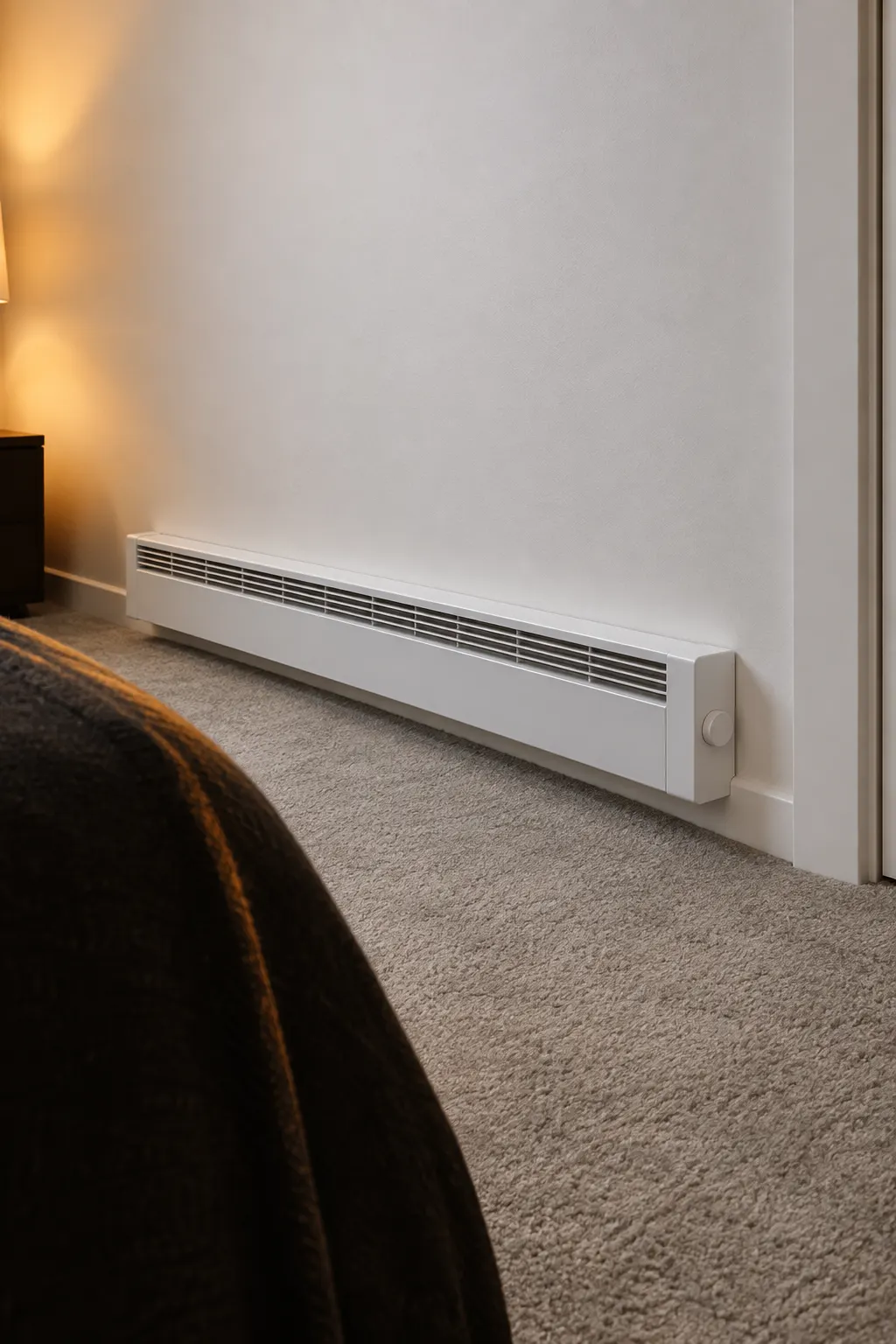
Licensed Electrical Contractor
Licensed and insured in British Columbia.
WorkSafeBC Registered
Active and in good standing.
BBB Accredited
Accredited since 2023.
Canadian family owned, working across British Columbia since 2019.
Get a quoteWhat does baseboard heater installation involve, and does it need a new circuit?
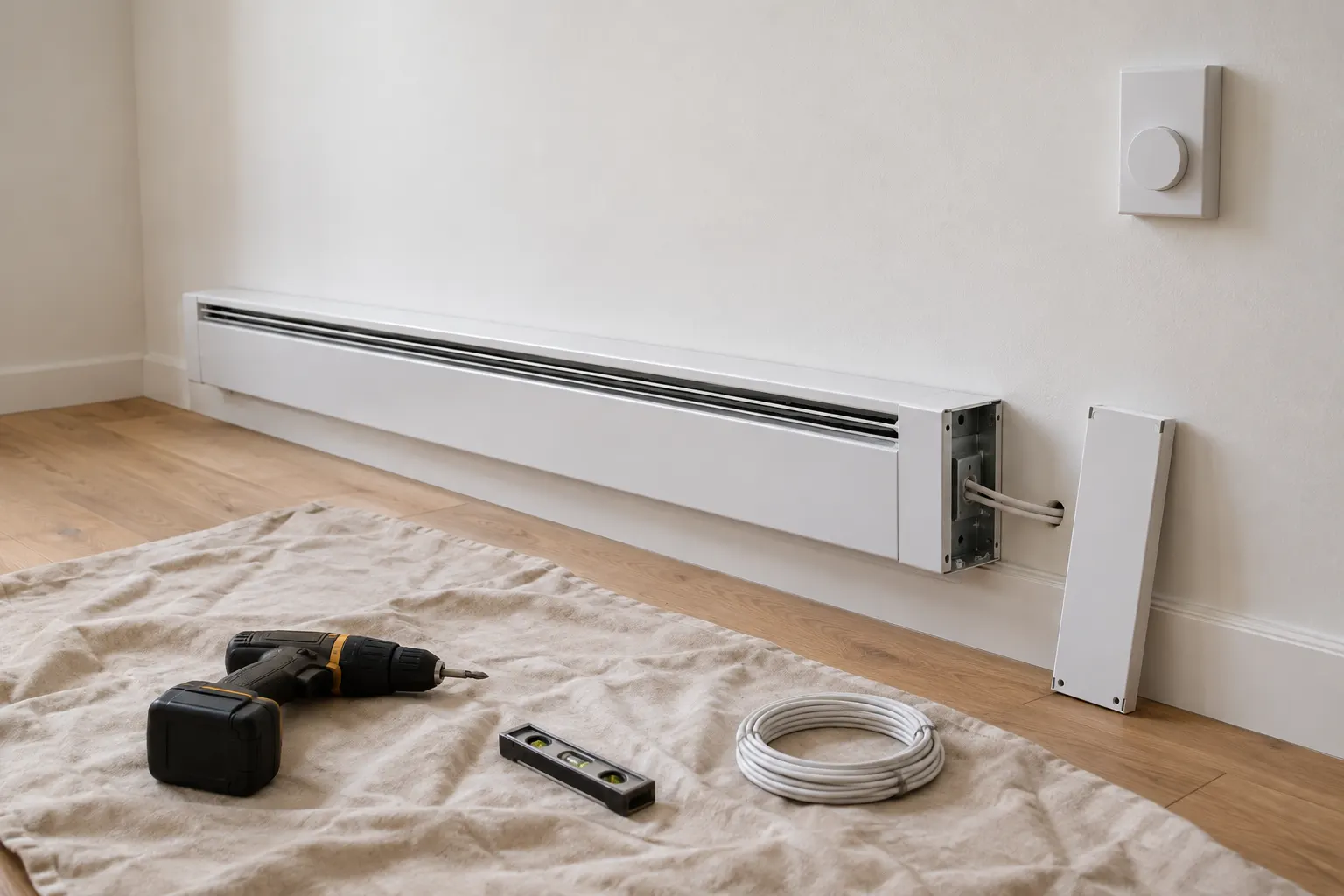
Baseboard heater installation means mounting an electric heater on the wall, connecting it to a heating circuit from your electrical panel, and hooking up the thermostat that controls it. If you are swapping an old heater for the same kind, the wiring already there can often be reused. A bigger heater, or one going in a new spot, usually needs a new circuit run from the panel. We do both kinds of job in homes across British Columbia.
- Estimates are free, and the work is billed at $135 an hour for a Red Seal electrician plus a helper.
- If your heater job needs a permit, we pull it, so the paperwork is ours, not yours.
Can I install or replace a baseboard heater myself, or do I need an electrician?
Replacing a baseboard heater yourself can be a small job if the new one matches the old one: the same wattage, the same voltage, the same spot, and wiring that already suits it. Some handy homeowners take that on by following the maker's instructions. In BC, a licensed contractor can replace an existing thermostat, switch or outlet without a permit. That rule is written for contractors, not homeowners, and it does not list heaters. Check the permit rules for homeowners where you live first.
Call an electrician to install baseboard heaters, or to replace one, if any of these is true:
- The new heater has a higher wattage than the one it is replacing.
- The heater is going in a new spot, or in a room with no heat yet, such as a basement or a new addition. That is often part of electrical work for a renovation.
- The label on the new heater shows a different voltage from the label on the old one.
- The wires you can see behind the old heater look brittle, cracked or cloth-covered.
If any of those is true, we do the work and run a new circuit where one is needed.
The five questions
Do baseboard heaters need their own circuit, and can your panel take it?
Yes. Baseboard heaters go on a dedicated heating circuit: a wire run from your panel, with its own breaker, that powers heaters and nothing else. One circuit can feed one heater or several, as long as it is sized for all of them. That is the rule for fixed electric heaters under the Canadian Electrical Code as adopted in BC.
Most baseboard heaters run on 240 volts, and smaller ones can run on 120 volts. A 240V baseboard heater draws less current (fewer amps) than a 120-volt heater of the same wattage, so the circuit can carry more heat. It does not use less power or cost less to run.
When we add a heater or fit a bigger one, the load is calculated before anything new goes on the panel. That load calculation checks whether your panel has room for the extra heat, so you know before the heater job starts whether the panel needs work first. If the panel is full, an electrical panel upgrade comes first. If the breaker on the old heater's circuit is worn, we swap it for a new breaker.
Baseboard heater installation cost: what changes the price
Baseboard heater work is charged at $135 an hour for a Red Seal electrician plus a helper, with flat rates on many jobs. The estimate is free, and you get the quote in writing before any work starts. A quote is priced on what we can see, so if the scope changes we tell you before we do it, not after.
Four things change the total:
- Reusing the old heater's wiring takes less time than running new wiring from the panel.
- Running wire a long way from the panel, or through finished walls and ceilings, takes longer.
- If your panel has no room for the extra heater, it needs an upgrade first, and that is a separate job.
- Adding a wall thermostat means more wiring than keeping the dial on the heater.
Whether you need one heater or one in every room, we price the job the same way: by the hour, or at a flat rate where the job suits one. A heater that has stopped working needs a repair, not an install, so the free estimate does not cover it. Tracing that fault is a 45-minute diagnostic for $165, which tells you what is wrong and how we will fix it.
To get a quote, call 778-708-0451. Tell us how many heaters you need and which rooms they go in. Let us know whether each one replaces an old heater or goes in a new spot, and read us the wattage and voltage from the old heater's label.
Baseboard heater sizing and placement
The room sets how big the heater should be, and the spot on the wall needs clear space around the hot grille.
Baseboard heaters are rated in watts. The right size depends on the room: how big the floor is, how well the walls and ceiling are insulated, how many windows and outside walls it has, and how high the ceiling is. Tell us the room size and whether it feels draughty, and we size the heater and check the circuit can carry it.
Where the heater goes matters too:
- Keep curtains, furniture and anything that can burn away from the heater.
- Leave a clear gap around the heater. That gap is called the baseboard heater clearance, and the maker lists how much your model needs. Keeping it clear stops the hot grille heating up whatever sits next to it.
- Most heater makers do not allow an outlet mounted directly above the unit, because a plugged-in cord would hang over the hot grille.
Should the baseboard heater thermostat change too?
Installing or replacing a heater is the best time to decide, because a wall thermostat is wired into the same circuit as the heater.
Change it if you want to control the room from the wall or on a schedule. If the dial on the heater suits you, keep it. We wire the new thermostat in as part of the heater job. A thermostat in each room gives you zone heating, so a bedroom can sit cooler than the living room.
Why a baseboard heater needs a line voltage thermostat
Baseboard heaters need a line voltage thermostat. That means the thermostat handles the heater's full power itself, turning the heater on and off directly. The thermostats many furnaces use work on a small, low-power signal instead, and they are not built to switch a baseboard heater on their own. A wall model can be programmable, or it can be a smart thermostat for baseboard heaters that you set from your phone.
Baseboard heater permits and inspections
If an inspection does not pass on our work, we put it right, call the inspector back, and we cover the cost.
Whether you need a permit for heater work depends on what is being done and who issues permits where you live. Adding a circuit, or a heater where there was none before, counts as new electrical work. The rules for a straight swap vary by city. In Abbotsford, Chilliwack, Mission and Langley, electrical permits come from Technical Safety BC. The City of Vancouver and the City of Victoria issue their own. We pull the permit whenever the job needs one, and we are there when the inspector comes.
When the old heater comes out
Baseboard heater replacement: signs it is time for a new one
The heater's condition, and how well it keeps the room warm, tell you more than its age does.
Replace one when you see these signs:
- The casing has started to rust, or the cover is cracked or bent.
- The room never gets warm enough in winter, which can mean the heater is too small for it.
- A renovation is putting new flooring, cabinets or furniture where the heater sits now.
- You want a thermostat on the wall instead of reaching down to the dial on the heater.
We also remove baseboard heaters a room no longer needs.
Sometimes taking out an old heater uncovers older wiring behind it, such as knob and tube wiring or aluminum wiring in an older BC home. If that happens, we tell you and get your approval before doing anything about it.
One panel, two kinds of job
- A like-for-like swap: the new heater reuses the circuit already in the wall.
- A bigger or moved heater: a new circuit runs to it from the panel.
A heater that has stopped working, or keeps tripping its breaker, needs baseboard heater repair, not a replacement. Finding the fault is a $165, 45-minute diagnostic, not part of the free estimate.
A dusty smell the first time a heater runs in the season is normal. A burning smell that keeps going is not: turn the heater off at its thermostat and call our emergency electrician service. If the heat goes out on a cold night, call us too. We answer the phone at any hour.
Our electric baseboard heater installation process
Every job follows the same steps, from the free estimate to the inspection.
- We look at the job for the free estimate and give you the quote in writing.
- If the job needs a permit, we pull it before work starts.
- If the heater is new or bigger, we do the load calculation to check your panel has room for it.
- We wire in the heater and its thermostat.
- We test the new heater and show you that it works.
- When the job is inspected, we are there when the inspector comes.
An apprentice's work is checked by a Red Seal electrician or a Field Safety Representative, every time. If the job needs materials beyond what your written quote covers, we tell you and get your approval before we use them.
What happens if a heater we installed is not right after we leave?
Call 778-708-0451 if a heater we put in is not working as it should, and we come back to put it right. Our work carries a one-year guarantee on new construction and six months on renovations.
If something we installed is not right, we come back.
What our customers say
Across 137 Google reviews we average 4.7 stars, and WorkSafeBC has covered us continuously since 30 September 2019. Two customers describe wiring and renovation work in their own words:
-
Needed power behind my new fireplace. I fully expected I would have to repair drywall and paint after an electrician was done.Jas arrived same day I called, laid out a plan where no drywall would be disturbed. Appointment made for 2 days later. Arrived on time, Nick and Nanek did a very clean job running line behind baseboards. Everybody was very polite and respectful.
-
Jas and his team are highly professional and reliable, the pricing is very fair and reasonable. I have used Jas for 3 retrofit/renovation jobs now, 1 of them being fairly large. Highly recommend.
Frequently asked questions
Any questions? Call 778-708-0451The Wire Guys Electrical Ltd. is a licensed electrical contractor serving Abbotsford, Vancouver, Victoria and communities across the Lower Mainland, Fraser Valley and Greater Victoria, handling residential and commercial electrical work for homeowners, landlords and business owners in British Columbia.
Are baseboard heaters efficient, and will a new one lower my bill?
Yes, in one way. Baseboard heaters use electric resistance heating, which turns all the electricity they use into heat. That means a newer model cannot be any more efficient. A new heater with the same wattage as the old one uses the same amount of electricity, so swapping one for the other will not lower your bill on its own. Your bill depends on how much heat the room needs and how long the heater runs. A wall thermostat that holds a set temperature, or turns the heat down on a schedule, is what changes how long it runs.
Are baseboard heaters safe, and do they need to be off the floor?
Yes, a baseboard heater is safe when it is installed following the maker's instructions, on a circuit sized for it. The grille gets hot while the heater runs, so bedding, toys and clothing should never rest on it or hang over it. The heater also sits a little off the floor, at the height the maker lists for that model, which keeps it clear of the carpet.
How long do baseboard heaters last?
Check the heater's condition, not its age. Replace a baseboard heater when the casing rusts, the cover cracks or bends, or it no longer keeps the room warm. One that still heats its room, with a sound casing and cover, can stay on the wall. A renovation or a need for more heat is also a good time to replace one.
What is the difference between a 2 wire and 4 wire electric baseboard thermostat?
A 2 wire thermostat, also called single-pole, has no true off setting, so it can still turn the heater on when the room gets cold. A 4 wire thermostat, also called double-pole, has a real off setting that cuts power to the heater completely, so it stays off. If you want a room's heat fully off between seasons, the 4 wire type is the one that does it.
Other electrical services we offer
Same licence on every one of them, with the permit and inspection wherever one applies.
Need heat in a cold room, a basement or an addition?
Call 778-708-0451 or ask us to call you back, and mention how many heaters you have in mind.