
Knob and Tube Wiring Replacement Across British Columbia
Still have old knob and tube wiring? The Wire Guys replaces it in older British Columbia homes, pulls the permit, and stays until the inspection passes.
Licensed Electrical Contractor
Licensed and insured in British Columbia.
WorkSafeBC Registered
Active and in good standing, with continuous coverage since 30 September 2019.
BBB Accredited
Accredited since 2023.
Canadian family owned, working across British Columbia since 2019.
Get a quoteHow does knob and tube wiring replacement work in British Columbia, and who pulls the permit?
We walk the house before we quote, and we quote from what we find rather than from a floor area. Then we pull the electrical permit under our own contractor licence, agree the room order and the wall openings with you, run new grounded cable room by room, and attend the inspection ourselves.
- We pull the permit in whichever municipality the job sits in. You do no paperwork.
- We agree the room order with you before anyone opens a wall.
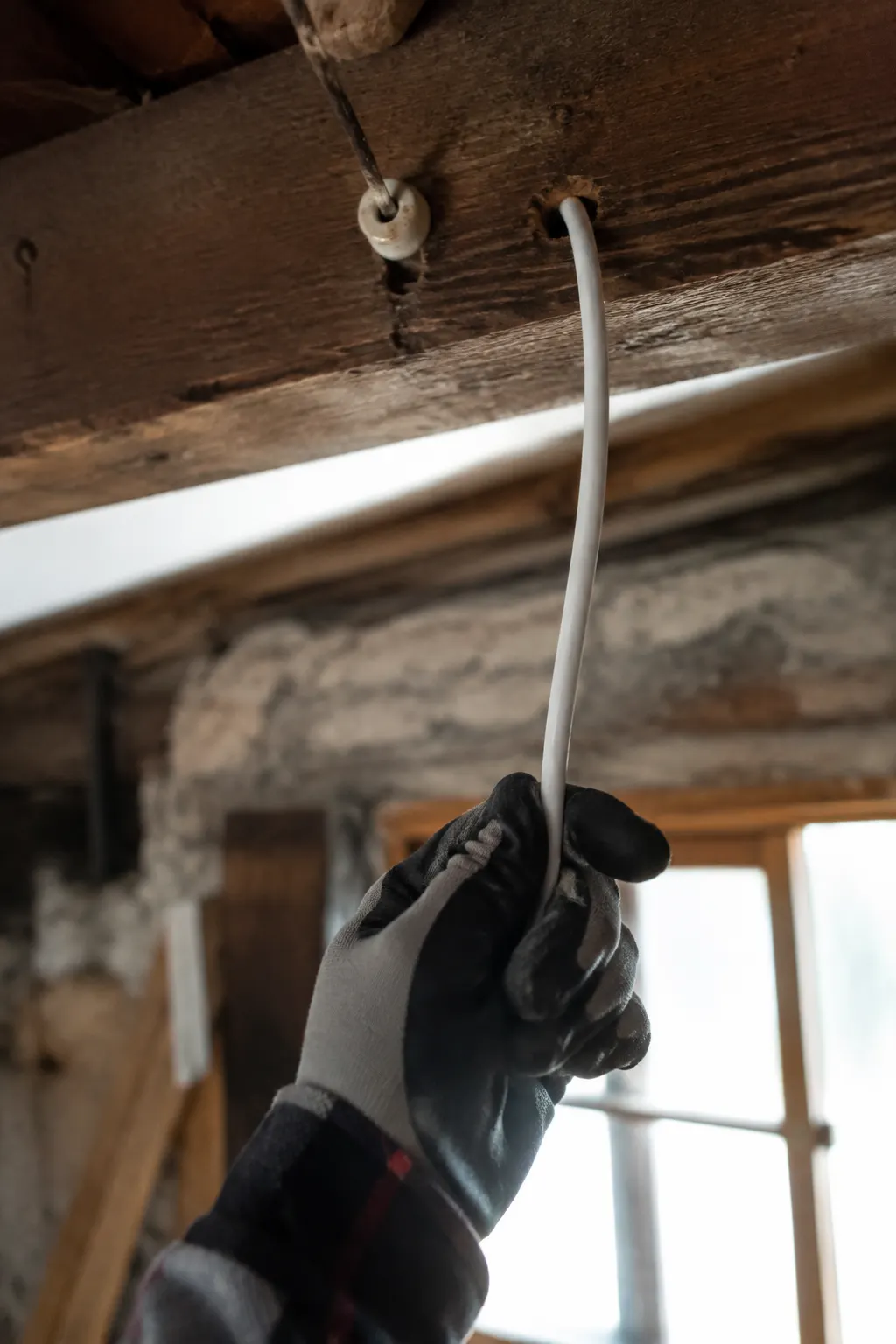
- We fish the cable through the attic and crawlspace where the access allows, so the walls stay shut.
- We are there for the inspection — every one.
What does knob and tube wiring look like?
You can usually spot it yourself. Take a torch into the attic, or look along the joists in an unfinished basement.
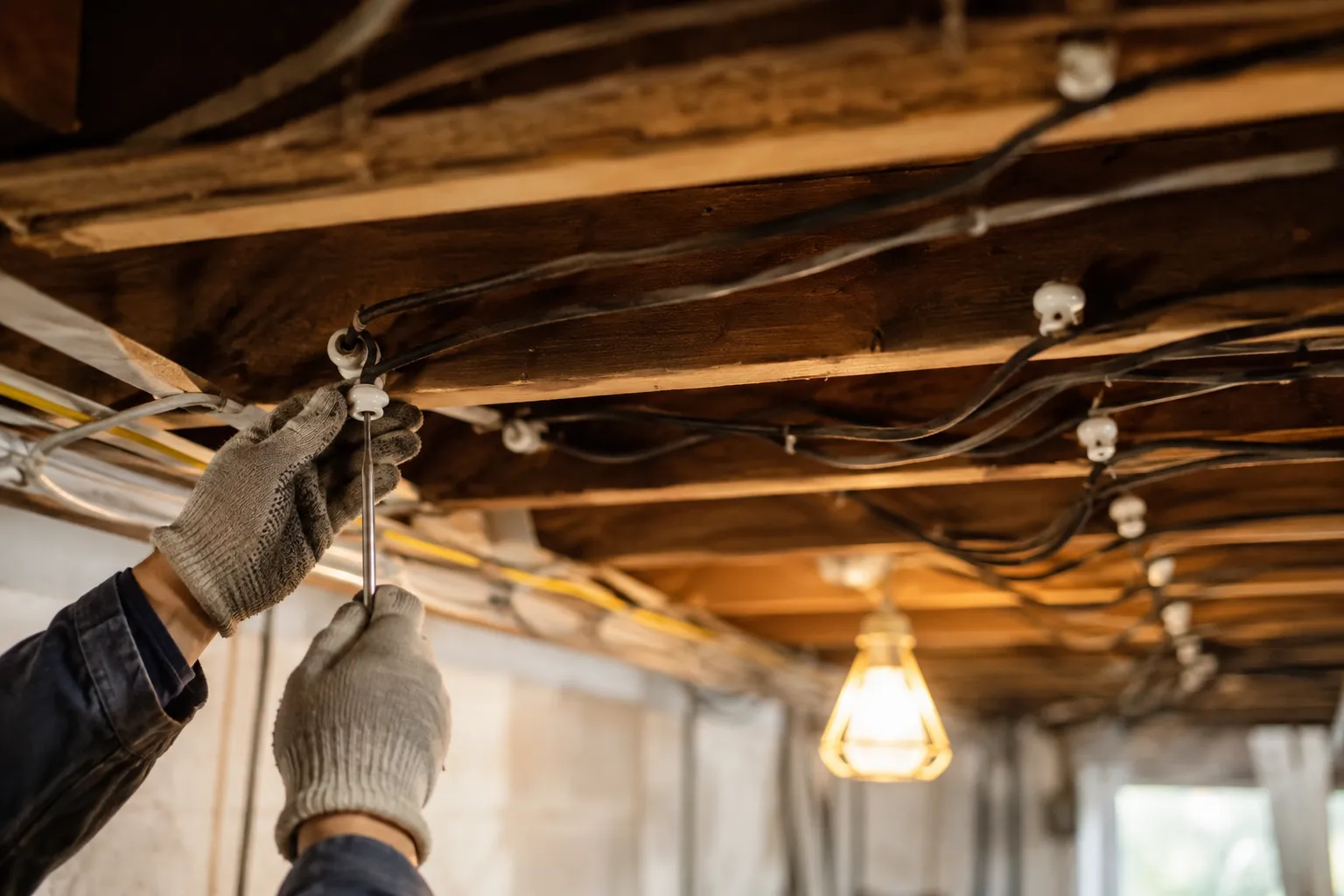
How to identify knob and tube wiring
- White ceramic knobs nailed to joists and rafters, a wire looped around each one.
- Porcelain tubes in drilled holes, so wire passes through timber inside a sleeve rather than touching it.
- Two separate wires running apart, often 15 to 30 centimetres of clear air between them. Modern cable keeps its conductors in one sheath.
- Fabric-looking insulation — cloth or rubber, often blackened, cracked or hanging off.
- Soldered joins wrapped in tape, in open air with no junction box.
- Two-prong outlets through the house, no round third hole.
Any two together and you're almost certainly looking at it. Photograph what you find, call us on 778-708-0451, and we can tell you what it is.
What is knob and tube wiring?
Knob and tube is the wiring method used in most British Columbia homes built before about 1950. Two separate conductors run apart — each looped around a ceramic knob and passed through a porcelain tube where it crosses timber — with no ground wire and no cable sheath. It is the two-wire method houses used before grounded cable existed, and replacing it means pulling new grounded cable through the same house, room by room.
How does knob and tube wiring work?
The two conductors are deliberately kept apart, each carried on its own ceramic knob and passed through a porcelain tube wherever it crosses a joist or stud. That spacing is the design: the system sheds heat into open air, so the air around each wire is doing a job.
When was knob and tube wiring used?
Knob and tube went into houses from the early 1900s to roughly the 1950s. Any pre-1950 house is worth a look in the attic.
What actually causes trouble
Why is knob and tube wiring dangerous?
Plenty has sat quietly for eighty years. What causes trouble is what has been done to it since.
- Brittle insulation. Rubber and cloth harden and crack with age, leaving bare copper against timber or metal.
- No ground. Two-prong outlets have nowhere to send a fault, which matters for anything with a metal case.
- Trapped heat. Attic insulation packed around the wiring takes away the one thing the design needed.
- Overfusing. A 15-amp circuit sitting behind a 30-amp fuse, so the fuse no longer protects the wire.
- Amateur splices. Decades of extensions joined in open air with no junction box.
If any of it is warm to the touch, smells of burning, or keeps tripping a breaker, treat it as urgent and call an emergency electrician — that is not a job to leave until next month.
- Two separate conductors, run apart, each on its own ceramic knob.
- A porcelain tube wherever the wire crosses timber, so it never touches the wood.
- Often 15 to 30 centimetres of clear air between them. That spacing is the design.
Then there is load. A system sized for a lamp and a radio now runs a kitchen, a heat pump, and often a Level 2 EV charger. Old house wiring was never asked to do that.
The four questions
Knob and tube wiring replacement cost
The estimate is free. We come out, look at what you have, and scope the work. If the problem is a fault we have to trace — a dead circuit, a breaker that keeps tripping — that is $165 for a 45-minute diagnostic: what the problem is, and how we are going to fix it.
Our published rate for hourly work is $135 an hour for a Red Seal electrician plus a helper. Two people on site, not one. Many jobs go out at a flat rate once we have seen them. A whole-house rewire is not one of the hourly ones — it is quoted on scope, and multiplying an hourly rate out will not give you a real number.
What decides the number on a rewire
- Access to the attic and the basement. Where we can fish new cable through from above or below, walls stay shut and the work moves faster.
- Plaster or drywall. Plaster is slower to open than drywall, and less forgiving when it goes back.
- How many circuits. More circuits means more runs, more terminations and more hours on site.
- Whether the panel is in scope. Old circuits often land back in a panel that was never built for them, so it is either part of the job or priced separately.
- How much of the old wiring is still live. Part of the house may already have been done by a previous owner, and what is left decides the size of the job.
What to ask any contractor for
- What is included, line by line, and what is excluded
- What happens when something is found behind a wall
- Whether the panel is in scope or priced separately
- Who patches the plaster and drywall afterwards
- Whether the permit and the inspection are in the number
What we can point you at is public: 4.7 stars across 137 reviews.
You get the quote in writing before any work starts. A quote is priced on what we can see. If the scope changes we tell you before we do it, not after.
Most people have no benchmark. One homeowner posted a whole-house rewire quote to a home-renovation forum with two lines under it:
"1461 sq ft home. A friend told me that was too much."
It drew hundreds of replies and no single right answer, because the answer depends on the house.
Does a house rewiring have to cover all of it?
Not always. A partial rewire is a real option, and often the right one on older houses. Some may already have been replaced by a previous owner, and what is left can be limited to one floor, an addition, or a couple of circuits.
What decides it is condition, load and what the inspection finds. Wiring that is brittle, buried in insulation, spliced badly or feeding rooms it was never meant to feed comes out. A run in sound shape, carrying a light load, in a house whose panel can handle it, may not have to. Whatever comes out, we show you what we found and explain why it needs replacing.
Ask whoever quotes the job whether house rewiring here has to cover the whole house, and on what basis.
Who pulls the permit, and who meets the inspector?
We do, on both counts.
This work needs an electrical permit in British Columbia, and we pull it ourselves in whichever municipality the job sits in. You do no paperwork. The permit goes out under our own contractor licence.
We are there for the inspection too — every one. Nobody hands you a folder and leaves you to explain old wiring to an inspector.
If someone offers to do this without a permit, be clear about what is being skipped: the inspection. Nothing gets checked by anyone outside the crew that did it, and there is no record to hand over when the house changes hands.
Do the walls have to come open?
Some of them, usually.
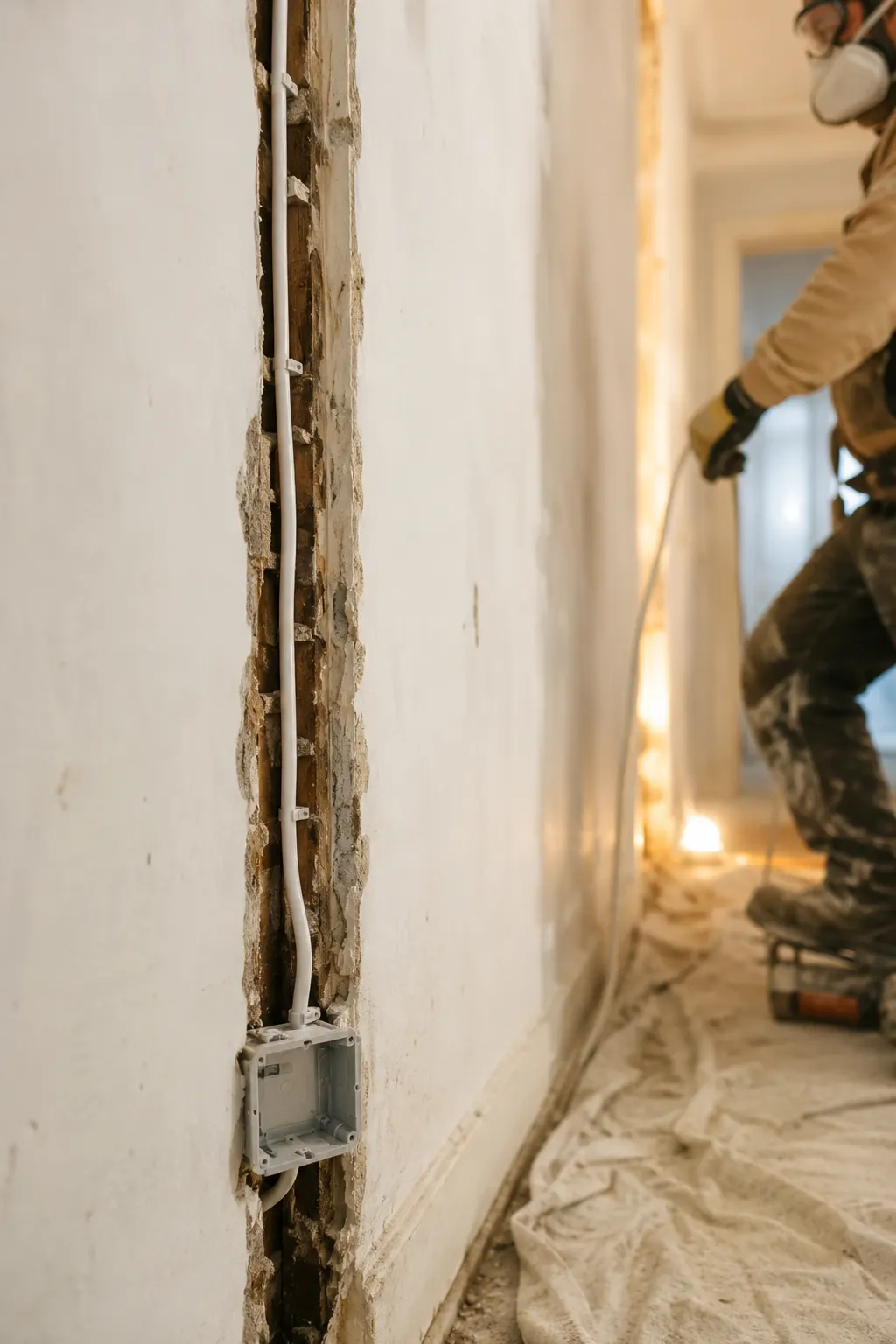
Where the attic and crawlspace give access, we fish the new cable through and the walls stay shut. That is as close as rewiring a house without removing drywall gets, and it does not cover a whole house. Where there is no path from above or below, we open the lower wall — some openings are unavoidable when you replace knob and tube wiring.
Residential runs use Romex — flat plastic-sheathed cable, the standard in modern houses. Conduit goes in on a rewire where the run needs it.
One homeowner buying a century home put it plainly on a forum:
"I'm just concerned this may open a worse can of worms, but also feel it's necessary for safety."
The honest answer is that the wiring is the part we control.
Asbestos, lead paint and making plaster or drywall good again are real considerations in a house from that era. They are not our trade.
Can I live in the house while it is being rewired?
Most people do. It is why we work room by room rather than opening the whole house at once. We plan the room order with you before we start, so you know which rooms are in play.
Knob and tube wiring and insurance, mortgages and home sales
A lot of these calls start with knob and tube wiring insurance — a letter from your insurer, or a broker asking what is in the walls. Some insurers restrict cover on a house that still has it, some decline outright. Every policy is different, so ask yours what it needs in writing.
Buying a house with knob and tube wiring, or selling one, brings its own catch. A clean home inspection report is not proof the house is free of it, and plenty turns up once somebody opens a wall for other work. If you are selling a house with knob and tube wiring, get ahead of it rather than discover it mid-sale.
If a date is attached to yours, tell us. We will say whether it is workable once we have walked the house.
Our knob and tube rewiring process
- 01
We walk the house and quote it — attic, basement, panel and every room, before a number is written down.
- 02
We pull the permit. You do no paperwork.
- 03
We agree the room order with you, and where a general contractor is already on site we coordinate with them and follow their recommendations.
- 04
We run the new cable through the attic and crawlspace where access allows, and through an opened wall where it does not.
- 05
We terminate at the panel, the outlets and the switches.
- 06
We show you the finished work.
- 07
The inspector comes out.
What happens at the end of a knob and tube removal?
We test it and show you it works before we leave.
Some faults can only be traced with the circuit live, which is why diagnosis is not left to an apprentice working alone.
If we find something unrelated behind a wall, we tell you and get your approval before doing anything about it.
If an inspector is not satisfied with something, they say what has to be corrected, and the work is corrected and re-inspected before the permit is closed. That is why we are in the house for the inspection rather than leaving you to relay it. If that happens on our work, we put it right, call the inspector back, and we cover the cost. Not you.
We give a one-year guarantee on new construction and six months on renovations. If something we installed is not right, we come back.
Where the new wiring connects
It ends at a panel, and at the outlets and switches you touch.
We install Square D panels and Leviton devices. Old knob and tube circuits often land back in a panel that was never built for them, so the panel is part of the conversation from the start.
Aluminum wiring is a different era with a different failure mode and a different fix, and we handle aluminum wiring separately.
Your knob and tube electrician
The Wire Guys Electrical Ltd. is a licensed electrical contractor serving Abbotsford, Vancouver, Victoria and communities across the Lower Mainland, Fraser Valley and Greater Victoria, handling residential and commercial electrical work for homeowners, landlords and business owners in British Columbia.
Canadian family owned, serving British Columbia since 2019. We work across the province, in Chilliwack, Mission and Maple Ridge as well as the bigger cities. Hiring an electrician for old house wiring is different from hiring one for a new build: the surprises sit behind plaster rather than on a drawing. A rewire is one of the bigger jobs in our residential electrical work.
We are a licensed electrical contractor in British Columbia, licensed and insured, and we pull the permit on every job.
What our customers say
Word for word from our public Google profile, typos and all. Both of these were new wire run through a house somebody was living in.
-
Needed power behind my new fireplace. I fully expected I would have to repair drywall and paint after an electrician was done.Jas arrived same day I called, laid out a plan where no drywall would be disturbed. Appointment made for 2 days later. Arrived on time, Nick and Nanek did a very clean job running line behind baseboards. Everybody was very polite and respectful.
-
Jas and his team are highly professional and reliable, the pricing is very fair and reasonable. I have used Jas for 3 retrofit/renovation jobs now, 1 of them being fairly large. Highly recommend.
Frequently asked questions
Some people call it a whole-house rewire, some call it knob and tube removal. Same work either way: new grounded cable through an old house, room by room. You can see the full range of electrical work we do on our services page.
The estimate is free, and a person answers the phone at any hour.
Any questions? Call 778-708-0451 Is knob and tube wiring illegal in Canada?
No. Having knob and tube in a BC home is legal, and nobody can force you to remove it. Adding to it is not. Under the BC Electrical Code, enforced by Technical Safety BC, it cannot be installed new or extended.
Is knob and tube wiring dangerous?
Not on its own. Knob and tube was built to the standard of its day and plenty is still sound. The danger comes from what happened since: insulation packed over conductors meant to shed heat, brittle sheathing, and old splices buried in ceilings.
What is the cost to rewire a house of 2,000 sq ft?
There's no honest square-foot number. How much to replace knob and tube wiring depends on the circuit count, the access we get, and how much finished wall comes off. We quote the cost to rewire a house after we have walked it, not from a floor area.
Do electricians charge for a quote?
Some do. We do not charge to quote work we can see — we walk the house, scope it and give you the number. The estimate is free. Tracing a fault is different: finding why a breaker trips takes time on the tools, and that is $165 for a 45-minute diagnostic.
Will an electrician leave holes in my walls?
Usually a few, yes. Old wiring sits inside finished walls, and we have to reach it. Where the access allows — an open basement, an attic — we fish the new cable through instead. Where it doesn't, the wall gets opened. Ask where the openings will be before work starts.
Is 100-year-old wiring safe, and does a house need rewiring after 25 years?
Age alone is not the test. A 1920s house with sound conductors and no insulation packed over the wire can be in better shape than a newer one added to for decades. We look at condition, how much has been altered, and whether there is a ground.
How long does it take to rewire a house?
It depends on the size of the house, whether you're living in it while we work, and the access. An open basement moves faster than plaster with no way in. We give you a schedule after we walk it, not over the phone.
Can I get home insurance with knob and tube wiring?
That is between you and your insurer, and it varies. The question to put to them in writing is plain: will insurance cover knob and tube wiring in this house, and on what terms? Only your insurer can answer it. We can tell you exactly what is in your walls first.
We have held WorkSafeBC coverage continuously since 30 September 2019 — ask anyone else you call for the same before you let them in.
Have this ready when you call:
- Whether we can get into the attic and the basement
- Whether the walls are plaster or drywall
- Roughly how many circuits, or how many rooms and outlets
- Whether you want the panel looked at as part of it
Other electrical services we offer
Same licence on every one of them, with the permit and inspection wherever one applies.
Book the free estimate
Call 778-708-0451 and we will come out, look at what is in your walls, and tell you what it would take to put it right. The estimate is free. Tracing a fault we cannot see is the one thing we charge for: $165 for a 45-minute diagnostic.