
Hot Tub Wiring Across British Columbia
Getting a hot tub or swim spa? The Wire Guys runs the power it needs across British Columbia, pulls the permit, and stays until the inspection passes.
Licensed Electrical Contractor
Licensed and insured in British Columbia.
WorkSafeBC Registered
Active and in good standing, with continuous coverage since 30 September 2019.
BBB Accredited
Accredited since 2023.
Canadian family owned, working across British Columbia since 2019.
Get a quoteHow does hot tub wiring work in British Columbia, and who pulls the permit?
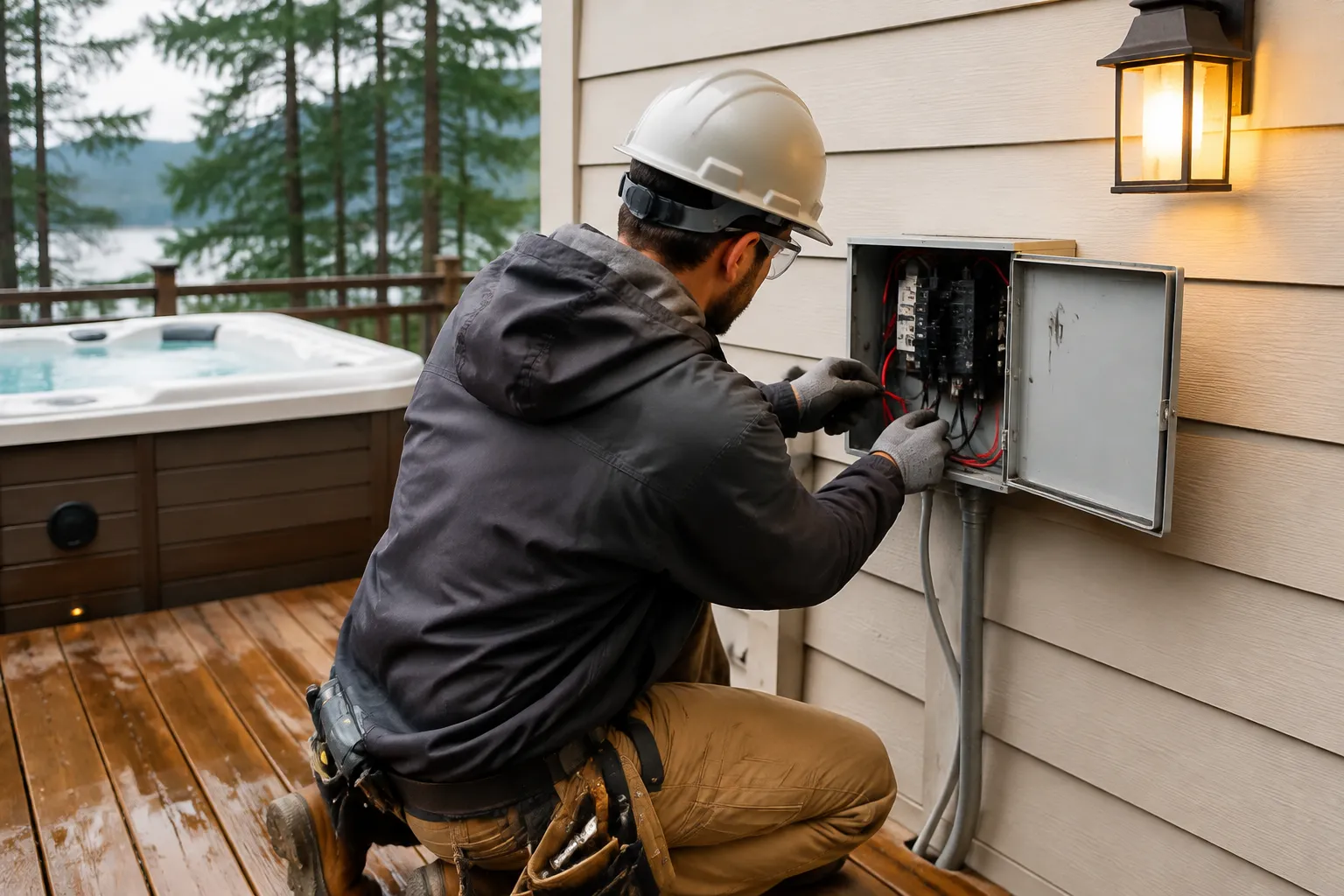
A hot tub needs its own dedicated 240V circuit, protected by a GFCI and fed to a disconnect you can reach without leaning over the water. We size the load against your panel first, pull the electrical permit under our own contractor licence, run the circuit, bond the tub, and attend the inspection ourselves.
- A dedicated 240V circuit, GFCI-protected, with nothing else sharing it.
- We pull the permit in whichever municipality the job sits in. You do no paperwork.
- A disconnect within sight of the tub, far enough back that you step out to reach it.
- We are there for the inspection — every one.
Hot tub electrical requirements in BC
Whatever tub you have bought — a Beachcomber, an Arctic Spa or an imported model — the electrical side is the same job, and it comes down to five things.
- Its own dedicated 240V circuit. A hot tub is a heater and a pump running together, so it gets a circuit of its own back to the panel — nothing else shares it.
- GFCI protection on that circuit. Water and electricity sharing a space is exactly what a GFCI breaker for hot tub installations is there to catch, and it is not optional near a tub.
- The right breaker and wire size for the tub. Most run on a 50-amp or 60-amp circuit, but the tub is what decides it, so the wire is sized to the load rather than to a habit.
- Bonding and grounding around the tub and its equipment, so every metal part sits at the same potential and there is nowhere for a fault to build up a difference you could feel.
- A disconnect you can reach without leaning over the water. It goes within sight of the tub but far enough back that you step out to reach it, never across it.
Photograph the plate on the side of your tub and call us on 778-708-0451, and we can tell you what the circuit needs before we come out.
What voltage does a hot tub need?
Nearly all built-in tubs run on 240V hot tub wiring — a dedicated 240V circuit back to the panel. A small plug-in portable can run on a 120V outlet, but the moment a tub heats and pumps at the same time it wants its own 240V supply, which is what most people are wiring for.
What size wire for a hot tub do you need?
The wire is sized to the tub, not to a rule of thumb. Most sit on a 50-amp or 60-amp circuit, and the wire gauge is chosen for that load and the length of the run, so a tub at the back of the yard is not wired the same as one against the house.
Why does a hot tub need a GFCI?
Because it is people in water. A GFCI watches the current leaving against the current returning and cuts the power in a fraction of a second if any of it is finding another path. On a hot tub that protection is required, not a nice-to-have.
Where water changes the job
Wiring a hot tub safely around water
A hot tub puts people, water and a heavy electrical load in one spot. Three things keep that safe, and none of them is optional.
- The GFCI is the first line. It watches the current going out against the current coming back and cuts in a fraction of a second if any of it is finding another path — through a person, most of all.
- Bonding ties the metal together. The tub shell, the frame, the pump and the nearby metal are bonded so they cannot sit at different voltages while someone is standing in the water.
- The disconnect stays in reach but out of the way. The hot tub disconnect box goes within sight of the tub, far enough back that a bather steps out to reach it. You should never have to lean across the water to kill the power.
- It is built for outdoors. The run, the box and the fittings are rated for a wet, weather-exposed spot, because that is where most tubs sit.
If a hot tub circuit is warm to the touch, smells of burning, or keeps tripping the moment you switch it on, treat it as urgent and call an emergency electrician rather than resetting it again.
- A dedicated 240V circuit runs from the panel with nothing else on it.
- A GFCI disconnect sits within sight of the tub, out of reach of the water.
- A bonding conductor ties the tub and its metal together at one potential.
A hot tub is a big dedicated load. If the panel is already full, we look at whether your panel has room for a hot tub circuit before anything is run.
The four questions
What hot tub wiring costs and what changes the price
The estimate is free. We come out, look at where the tub goes and how far it sits from the panel, and quote the work. If the tub is already in and the problem is a fault we have to trace — a breaker that keeps tripping — that is $165 for a 45-minute diagnostic: what the problem is, and how we are going to fix it.
Our published rate for hourly work is $135 an hour for a Red Seal electrician plus a helper. Two people on site, not one. Many jobs go out at a flat rate once we have seen them. What we will not do is quote a hot tub over the phone, because the number lives in the run to the tub and the state of your panel, not in a price list.
What changes the price
- How far the tub is from the panel. A short run in an open basement is quick; a long run out to the back of the yard is more cable, more hours and sometimes a trench.
- Whether the panel has room. A hot tub is a big dedicated load. If the panel is already full, making space for it is either part of the job or a separate one, and we tell you which before we start.
- The route to the tub. Fishing through a finished wall, going under a deck, or crossing a patio each take a different amount of work to reach the spot the tub sits in.
- The permit. A hot tub circuit needs an electrical permit in BC, and that is a real line in the number rather than something folded away out of sight.
What to ask any contractor for
- A dedicated circuit, not a spare slot shared with something else
- GFCI protection and a disconnect placed to code
- Whether the panel has room, or needs work first
- Whether the permit and the inspection are in the number
- What happens to the price if the run is longer than it looked
What we can point you at is public: 4.7 stars across 137 reviews.
You get the quote in writing before any work starts. A quote is priced on what we can see. If the scope changes we tell you before we do it, not after.
What's included in a hot tub wiring installation
A hot tub wiring installation is a whole circuit, start to finish, not just the last connection at the tub. What we do on the job is the same list every time:
- A dedicated 240V circuit from the panel to the tub, sized to the tub's load.
- GFCI protection and the disconnect, placed within sight of the tub and out of reach of the water.
- Bonding and grounding for the tub and its equipment.
- The permit, pulled and the inspection attended, so the circuit is signed off, not just switched on.
- A test, and we show you it works before we leave.
If your panel needs work to carry the load, we tell you that up front — it is part of the conversation, not a surprise once the trench is open.
Permits and inspection for a hot tub circuit
We pull the permit and we meet the inspector. Both.
A hot tub circuit needs an electrical permit in British Columbia. The hot tub wiring code we work to is the Canadian Electrical Code, enforced here through Technical Safety BC, and the permit is how the work gets checked against it. We pull it ourselves in whichever municipality the job sits in, under our own contractor licence. You do no paperwork.
We are there for the inspection too — every one. Nobody hands you a folder and leaves you to explain the wiring to an inspector.
If someone offers to wire your tub without a permit, be clear about what is being skipped: the inspection. Nothing gets checked by anyone outside the crew that did it, and there is no record to hand over when the house changes hands.
Plug-in or hard-wired: which hot tub circuit you need
A small portable tub can run on a 120V plug, and if that is genuinely what yours is built for, it is the simplest path. Most tubs are not. A full-size tub heats and pumps at once, and for that it wants a dedicated 240V circuit of its own — which is the job most people are really asking about.
The catch is the panel. A dedicated 240V circuit is a real load, and an older panel may already be full. That is why we check whether your panel has room for a hot tub circuit before we quote the run, so the answer is not a surprise halfway through.
Tell us the make and model of the tub, and we will tell you which of the two it needs before we come out.
Our hot tub wiring process
- 01
We size the load against your panel first — a hot tub is a big draw, so before anything else we work out whether the panel can carry it.
- 02
We pull the permit. You do no paperwork.
- 03
We run the dedicated 240V circuit from the panel out to where the tub sits.
- 04
We fit the GFCI protection and the disconnect within sight of the tub and out of reach of the water.
- 05
We bond the tub and its equipment.
- 06
We test it and show you it works before we leave.
- 07
The inspector comes out.
Before anything is run
The load calculation comes first on every hot tub, every EV charger and every heat pump we add. A hot tub is a big dedicated draw, so we work out whether the panel can carry it before we run a metre of cable — because finding that out at the end is how a job goes wrong.
Our guarantee, and standing behind the work
We test it and show you it works before we leave.
A hot tub GFCI can be a fussy thing, and tracing why one trips can take a live circuit to do it, which is why diagnosis is not left to an apprentice working alone.
If we find something unrelated while we are in there, we tell you and get your approval before doing anything about it.
If an inspector is not satisfied with something, they say what has to be corrected, and it is corrected and re-inspected before the permit is closed. That is why we are there for the inspection rather than leaving you to relay it. If that happens on our work, we put it right, call the inspector back, and we cover the cost. Not you.
We give a one-year guarantee on new construction and six months on renovations. If something we installed is not right, we come back.
Where the hot tub circuit connects
It ends at a GFCI spa panel or disconnect, and back at your main panel.
We install Square D and Eaton spa panels and disconnects, and Leviton devices. The GFCI spa panel is the part that both protects the tub and gives you the shut-off within reach.
Back at the house, a hot tub often lands in a panel that has no room to spare, so the panel is part of the plan from the start.
Your hot tub electrician
The Wire Guys Electrical Ltd. is a licensed electrical contractor serving Abbotsford, Vancouver, Victoria and communities across the Lower Mainland, Fraser Valley and Greater Victoria, handling residential and commercial electrical work for homeowners, landlords and business owners in British Columbia.
Canadian family owned, serving British Columbia since 2019. Our hot tub wiring service runs from hot tub wiring in Abbotsford out across the Fraser Valley. Getting the electrical side of a hot tub right is a small job done properly rather than a big one — a dedicated circuit, the GFCI, the bonding and the permit — and it is one we do as part of our residential electrical work.
We are a licensed electrical contractor in British Columbia, licensed and insured, and we pull the permit on every job.
What our customers say
Word for word from our public Google profile, typos and all. Both of these were a new dedicated circuit run and tested — one for a hot tub, one for a 240-volt appliance.
-
Jas came and set up our electrical for our new hot tub and also helped us out by fixing some of our outlets that weren't working properly. He did a wonderful job and we would recommend him to anybody. He is very professional and also good communication and lets you know everything he is doing.
-
Jas and His Team did an amazing job in My new to Me Home of installation of 220v power and exhaust to accommodate a dryer and solved some other electrical issues. So grateful for Their work and professionalism.
Hot tub wiring FAQ
Some people call it a hot tub hookup, some call it spa wiring. Same work either way: a dedicated GFCI circuit, wired to code and inspected. You can see the full range of electrical work we do on our services page.
The estimate is free, and a person answers the phone at any hour.
Any questions? Call 778-708-0451 My hot tub breaker keeps tripping — is it the wiring?
Often it is the tub, not the circuit. A GFCI trips the moment it senses current leaking to ground, and on a hot tub that is usually moisture in the spa pack or a failing heater element rather than the branch wiring. Finding which one it is takes time on the tools: the estimate is free, but tracing a fault is $165 for a 45-minute diagnostic.
Do I need a permit to wire a hot tub in BC?
Yes. A hot tub needs its own circuit, and that circuit needs an electrical permit in British Columbia. We pull it ourselves in whichever municipality the job sits in, under our own contractor licence, so you do no paperwork, and we are there for the inspection at the end.
Does a hot tub need a dedicated circuit?
Yes. A hot tub runs a heater and a pump at the same time, so it takes its own circuit back to the panel with nothing else sharing it. That is why the first thing we check is whether your panel has room for one before anything is run.
What size breaker for a hot tub do I need?
It depends on the tub. Most sit on a 50-amp or 60-amp GFCI circuit, but the plate on your tub is what decides it, and the wire is sized to match. We cover the sizing in full in our guide on what size breaker a hot tub needs.
What does it cost to wire a hot tub?
There is no single number, because it depends on the run from your panel, whether the panel has room, and the route to the tub. The estimate is free — we come out, look at where the tub goes, and quote it. Our guide on what it costs to wire a hot tub walks through what moves the price.
Will you leave holes in my walls?
Sometimes a few, where the cable has to cross a finished wall to reach the tub. Where an open basement, a crawlspace or an outdoor route lets us get there instead, the walls stay shut. Ask us where any openings will be before the work starts, and we will show you.
Why would the final bill be higher than the quote?
A quote is priced on what we can see. If the run turns out longer than it looked, the panel needs work to take the load, or you change where the tub goes, that moves the number — and we tell you before we do it, not after. You get the quote in writing before any work starts.
How do I check an electrician is licensed and insured?
Ask for their licensed-contractor status in writing, ask who pulls the permit and who attends the inspection, and check the permit is filed before work starts. Look them up on WorkSafeBC, and read reviews on a profile the company does not control. We are a licensed electrical contractor in British Columbia, licensed and insured, WorkSafeBC covered since 2019.
We have held WorkSafeBC coverage continuously since 30 September 2019 — ask anyone else you call for the same before you let them near a wet-location circuit.
Have this ready when you call:
- The make and model of the tub, if you have it, or its amp rating off the plate
- Roughly how far the tub sits from your electrical panel
- Whether there is an easy route to it, or a deck or patio in the way
- Whether you want the panel looked at as part of it
Other electrical services we offer
Same licence on every one of them, with the permit and inspection wherever one applies.
Book the free estimate
Call 778-708-0451 and we will come out, look at where the tub goes and how far it sits from your panel, and tell you what the circuit takes. The estimate is free. Tracing a fault we cannot see is the one thing we charge for: $165 for a 45-minute diagnostic.