
Emergency Electrician Across British Columbia
The Wire Guys are a licensed electrical contractor across British Columbia, open 24 hours for homes, businesses and strata. If something has just gone wrong at your place, start with the checks below — a lot of faults turn out to be a tripped breaker or a GFCI waiting to be reset, and we would rather you found that in five minutes than paid us to.
4.7 from 137 Google reviews Read them on Google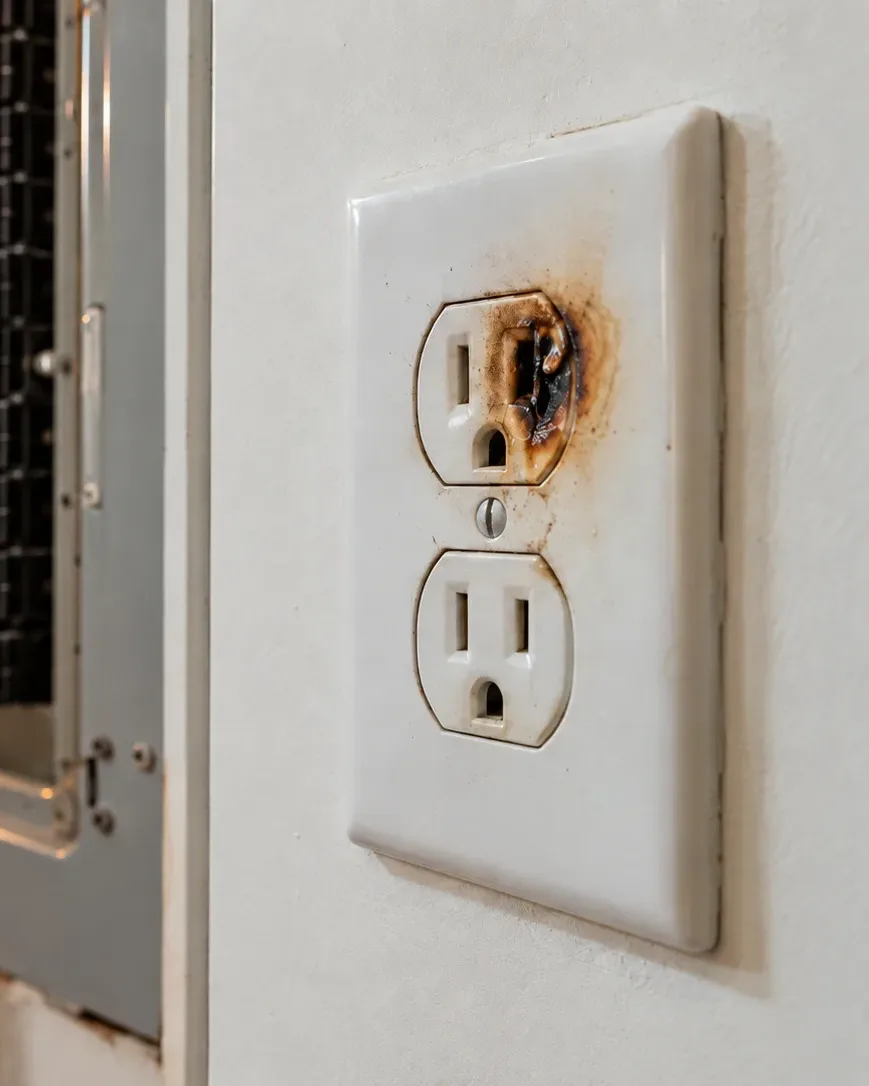
Licensed Electrical Contractor
Licensed and insured in British Columbia.
WorkSafeBC Registered
Active and in good standing.
BBB Accredited
Accredited since 2023.
Canadian family owned, working across British Columbia since 2019.
Get a quoteWhat should you do first in an electrical emergency, and when do you need an emergency electrician?
Check three things before you call an emergency electrician: whether the whole street is dark, whether a breaker has tripped, and whether a GFCI needs resetting. Those three cover most dead outlets and dead rooms. Stop and call if you can smell burning plastic, see scorch marks or sparking, hear buzzing at the panel, or a breaker will not stay on.
- Is it one outlet or the whole room? That tells you whether to look at the outlet or at the panel.
- Check the panel for a tripped breaker. A tripped breaker often sits between on and off, not hard off.
- Check for a tripped GFCI — the outlet with test and reset buttons, usually in a bathroom, kitchen, garage or outside.
- If the whole street is dark, check BC Hydro's outage map. That is not your wiring and it is not your bill.
The four questions
What to check before you call an emergency electrician
Work through this list first. It costs nothing and it takes about five minutes.
- Is it one outlet, one room, or the whole house? One dead outlet points at the outlet or at the thing plugged into it. One dead room points at a breaker. A partial power loss in house circuits — half the lights out and the rest fine — points at the panel or at the supply coming in. The whole street dark is BC Hydro's problem, not yours.
- Has a breaker tripped? Open the panel and look along the row. A tripped breaker usually sits in the middle rather than hard off, which is why it is easy to miss. Push it fully off, then firmly back on. If it holds, plug things back in one at a time and watch which one takes it out again.
- Is it the appliance? Unplug everything on that circuit, reset the breaker, then plug things back in one at a time. Plenty of dead circuits turn out to be one failed kettle, heater or power bar.
- Is a switch just off? More than one dead outlet has been a wall switch somebody knocked. Worth thirty seconds before anything else.
GFCI won't reset? Try this first
A GFCI is the outlet with the two small buttons marked test and reset. They live in bathrooms, kitchens, garages, basements and outside, and one of them often feeds several ordinary outlets further down the line. So a dead bedroom plug can be a tripped GFCI out in the garage. Press reset firmly — you should feel it click.
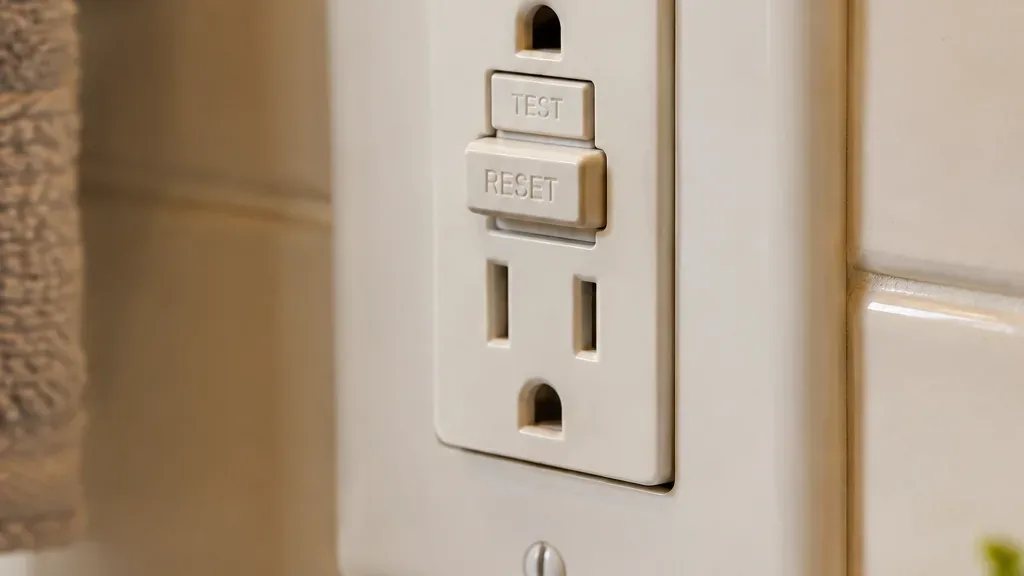
If the GFCI keeps tripping, or it will not reset at all, something on that circuit is leaking current to ground. Often that is a wet outdoor outlet after a run of rain. Sometimes it is the GFCI itself, worn out. Unplug everything on the circuit and try once more. If it still will not hold, leave it off and call.
Three more you will recognise:
- Power flickering on and off across the whole house when a big appliance starts is usually the supply or a loose connection ahead of the panel. Worth a call. Not usually worth 2am.
- A breaker that keeps tripping is telling you the circuit is carrying more than it should, or there is a fault on it. Do not keep resetting it.
- An outlet not working with nothing tripped is usually a GFCI or a wall switch. If both are fine, it is a fault in the wiring behind the wall.
When to call an emergency electrician, and when it can wait until morning
Most electrical faults wait.
If the fault could start a fire or shock someone, it is now. If it is an inconvenience, it is the morning. Heat, smell, smoke, sparks and water are the now list. A dead circuit with nothing hot and nothing smelling is almost always the morning list.
These usually wait:
- One dead outlet with nothing else wrong
- A breaker that tripped once, reset, and has stayed on since
- A light fitting that has stopped working
- A room with no power on a mild day, with nothing hot to touch
These do not wait. The short version is anything you can smell or see burning, anything sparking, water near the panel, and a breaker that will not stay on.
One symptom on its own is usually an annoyance. A second symptom is what turns it into a call. A dead outlet is a dead outlet. A dead outlet plus lights flickering in the same part of the house is a different problem, and that one is worth phoning about the same night.
What an emergency electrical service costs
An emergency electrical service is priced here the same way our daytime work is.
Our rate is $135 an hour for a Red Seal electrician plus a helper — the same rate at 3am as at 3pm. That is two people on site, not one. There is no night rate. Plenty of jobs go out at a flat rate instead, once we have seen the work.
One outlet or a full rewire, priced the same way. We come out for the small jobs.
The consultation and the estimate are free. Tracing a fault is not. Fault-finding is $165 for a 45-minute diagnostic, and what it buys you is a straight answer: what the problem is, and how we are going to fix it. We print that number because a company that says everything is free and then hands you an invoice is how people end up angry. Better you know it before you dial.
You get the quote in writing before any work starts. A quote is priced on what we can see — if the scope changes we tell you before we do it, not after.
Permits, inspections, and what happens after an emergency repair
A night call ends one of two ways: the fault is found and the circuit is made safe, or the repair turns into permitted work. It is worth knowing which is which before anyone starts pulling things apart.
Making a circuit safe — taking a failed breaker out of service, disconnecting a burnt outlet, isolating a damaged run — is repair. Replacing a panel, running a new circuit, or rewiring a section of the house is permitted work in British Columbia, and it has to be filed and inspected.
- We pull the permit for whichever municipality your address sits in. You fill in nothing.
- We are there for the inspection. You are not left explaining someone else's wiring to an inspector.
- If an inspection does not pass on our work, we put it right, call the inspector back, and we cover the cost. Not you.
- We show you what we found and explain why it needs replacing — including anything unrelated we come across on the way. We tell you and get your approval before doing anything about it.
Who issues the permit depends on the city. Abbotsford, Chilliwack, Mission and Langley go through Technical Safety BC. Vancouver, Victoria, Surrey and Burnaby run their own electrical permit offices. Working out which one applies is our problem, not yours.
A fault traced at night sometimes turns out to be the panel itself: a breaker that will not hold because the panel is full, or old enough that parts are no longer made. That is an electrical panel upgrade, quoted properly in daylight, not something anyone should be selling you at 2am. The same goes for a recurring fault in old cloth-covered wiring or knob and tube wiring, and for a circuit that trips every time the car goes on charge, which is an EV charger installation problem rather than an emergency one.
Calls to make now
Signs of an electrical emergency
These are the signs of an electrical fire in the making. Any one of them on its own is a call now:
- A smell of burning plastic in the house or the garage, with nothing on the stove
- Scorch marks, browning or melted plastic around an outlet, switch or breaker
- An outlet sparked, or sparks when something is plugged in or pulled out
- Buzzing sound from electrical panel, breaker or switch
- A hot outlet, switch or cover plate
- Water anywhere near the panel
- A breaker that trips again the moment you reset it
- Part of the house dead, with any of the above
A buzzing outlet is the same signal at the other end of the circuit. Something is arcing, and arcing is heat.
The smell of burning plastic in house wiring: call right away
Burning plastic is insulation. Insulation only melts when something behind it is running hot, and what runs hot is almost always a loose connection carrying current it cannot hold. That is why this is the one sign nobody should sleep on.
If you know which circuit the smell is coming from, switch that breaker off. If you do not, leave the panel alone and call. If you can see smoke or flame, you are past us. That is 911.
Breaker won't reset? Leave it off
A breaker that will not reset is doing its job. Something on that circuit is still faulty and the breaker is refusing to feed it.
Do not keep trying. Every reset puts current back into a fault nobody has found yet. A homeowner asking about this on a public forum got the plainest answer we have read anywhere: "STOP turning the breaker back on. You could start a fire. The breaker is trying to help you." That is exactly right.
Leave it off. That circuit is dead until someone traces it, and a dead circuit overnight is a far smaller problem than the alternative.
Downed lines, power outages and fires: who to call first
There are three situations where phoning an electrician costs you time you do not have.
- Fire, smoke, or someone has been shocked — call 911. Get out first. Nothing else comes before that.
- A power line down, or a line arcing in a tree — call BC Hydro, or 911 if anyone is near it. Stay well back and keep other people back. That line is theirs, and it is not safe to be close to.
- The whole street dark — check BC Hydro's outage map first. An outage is not your wiring, and nobody should be charging you to find that out.
We will tell you the same thing if you ring us instead. Knowing first just gets you to the right number. You can check BC Hydro's outage map yourself in about ten seconds.
- A connection made up tight: current passes, nothing heats.
- The same connection loose: resistance rises, and the joint is where the heat goes.
Calling a 24 hour electrician: what happens next
- 01
A person answers, whatever time it is
We are open 24 hours, and we answer the phone at any hour.
- 02
What to have ready: what you can see, hear and smell
Most of what a fault call turns on comes out of the first two minutes: whether it is one outlet or the whole house, whether anything is hot, whether a breaker will hold. Those three answers are worth having before you dial.
- 03
What you can safely do while you wait
Switching off the one affected breaker is usually enough to make a circuit safe until it can be traced. Unplugging whatever the fault followed is the other. And a fault with nothing hot and nothing smelling can usually wait for daylight.
- 04
We book a time with you
We answer the phone at any hour. What we will not do is promise an arrival time before we know what the job is. When you call, we book a time with you.
- 05
We trace the fault, then price the repair
Fault-finding is the $165 45-minute diagnostic. At the end of it you know what is wrong and what fixing it involves, and the repair goes to you in writing before we start it.
- 06
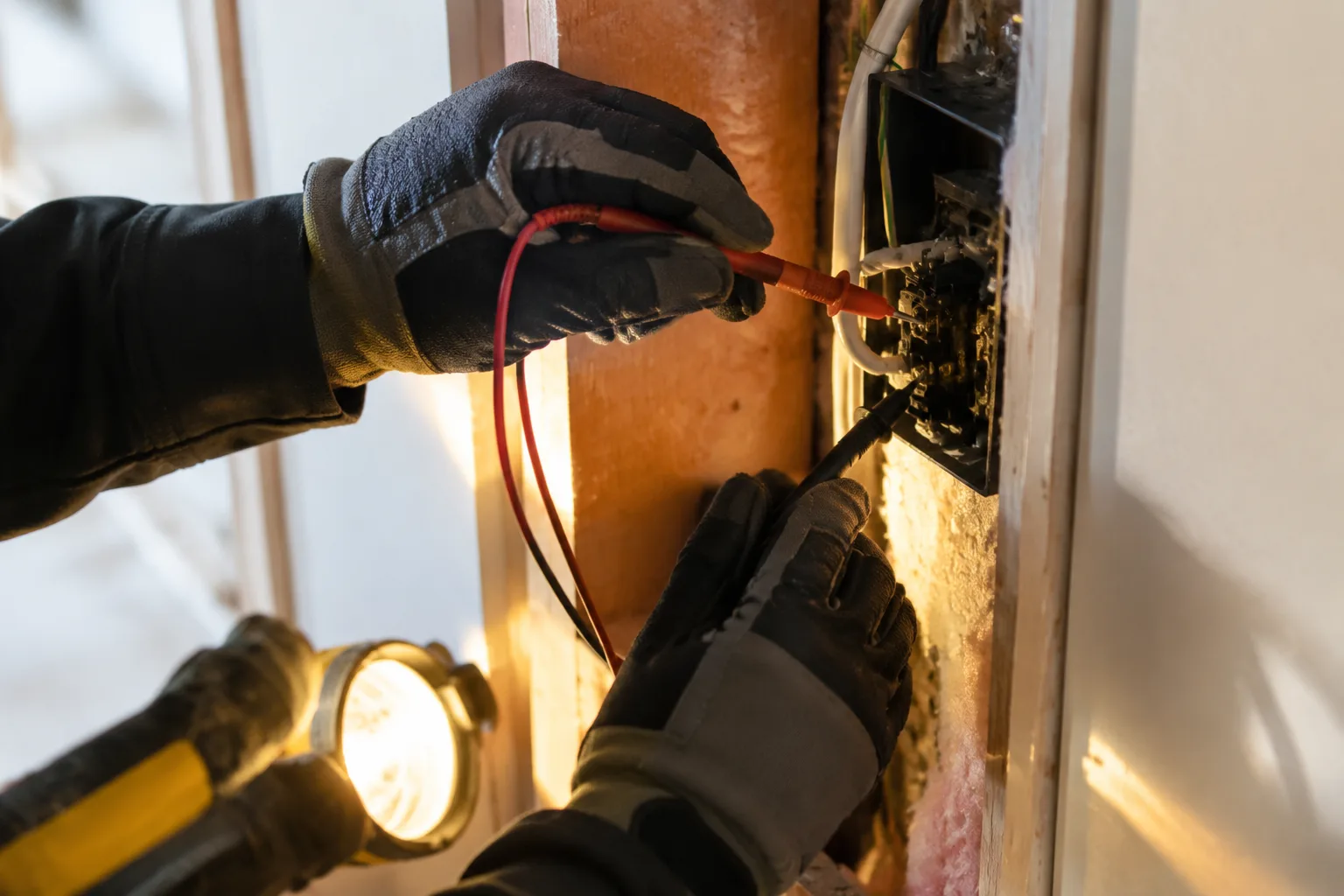
We test it and show you it works before we leave
You should not have to find out later whether it holds.
An after hours electrician here is the same company and the same rate as the one you would get on a Tuesday afternoon. That is deliberate. We are based in Abbotsford and work across the Fraser Valley, the Lower Mainland and Greater Victoria — Chilliwack, Mission, Langley, Vancouver and Victoria included. What a normal week looks like for us is on our electrician in Abbotsford page.
What happens if something is wrong after we leave
Four things happen on every job, before we go anywhere:
- If we find anything unexpected, we talk it through with you and get your approval before any extra work begins.
- An apprentice's work is checked by a Red Seal electrician or a Field Safety Representative, every time.
- We show you what we found and explain why it needs replacing.
- We test it and show you it works before we leave.
You call the same number you called the first time and you reach the same company.
If something we installed is not right, we come back.
What our customers say
Both are repair jobs — a chronic breaker fault, and a call-out that turned into a plan. Word for word from our public Google profile, typos and all.
-
Just want to say thank you so much to Jaz and his crew. He took the time out of a very busy work day and personal schedule to come and assist me with my issues in my home. He made what could easily have been a much more traumatic electrical experience into a calm well thought out affordable plan His work was top-notch and I highly recommend The Wire Guys Electrical Ltd to everyone looking for an honest thorough good electrician. I will be calling the Wire Guys for future endeavours as I have a few projects. I’m looking at right now. Thank you again.
-
I am thrilled with the top notch job The Wire Guys (Jas and Guri) did for me - wall plug replacement, troubleshooting & fixing a chronic breaker issue, AND installing the proper support hardware for a ceiling fan. These guys were knowledgeable, polite, thorough, clean, and met their ridiculously reasonable quoted price. Would I recommend them? Absolutely!!! Thank you thank you thank you!
Frequently asked questions
The Wire Guys Electrical Ltd. is a licensed electrical contractor serving Abbotsford, Vancouver, Victoria and communities across the Lower Mainland, Fraser Valley and Greater Victoria, handling residential, commercial and strata electrical work for homeowners, landlords and business owners in British Columbia. You can see the full range of electrical work we do on our services page, and the small jobs we come out for as well.
The estimate is free. Tracing a fault is $165 for a 45-minute diagnostic.
Any questions? Call 778-708-0451The Wire Guys Electrical Ltd. is licensed and insured, WorkSafeBC registered with continuous coverage since 30 September 2019, and BBB Accredited. Canadian family owned, serving British Columbia since 2019.
What is considered an electrical emergency?
Anything that could start a fire or shock somebody. In practice that means a burning smell, scorch marks, smoke, sparking, a hot outlet or switch, buzzing at the panel, water near the panel, or a breaker that trips again the moment you reset it. A dead outlet, a dead room, or a light that stopped working are faults, not emergencies. They can safely wait for daylight.
No power but breaker not tripped — what should I check?
Check for a tripped GFCI first, in the bathroom, kitchen, garage or outside, because one GFCI often feeds several ordinary outlets. Then check for a wall switch that controls that outlet. Then unplug everything and reset the breaker fully off and on. If power still does not come back with nothing tripped anywhere, it is usually a failed connection behind the wall, and that needs tracing.
Should I call an electrician for a tripped breaker?
Not for a one-off. A breaker that tripped once, reset, and has held since was doing exactly what it is for. Call if it trips repeatedly, if it will not stay on, if it trips with nothing plugged in — an arc-fault breaker, or AFCI, trips on arcing, not on load — or if the breaker or the panel around it feels warm. Those four mean there is a fault on that circuit, not just too much load.
How many times can you reset a tripped breaker?
Once. If it holds, unplug things and add them back one at a time to find the culprit. If it trips again straight away, stop there and leave it off. Every reset pushes current back into a fault nobody has found yet, and repeated arcing at a loose connection is how wiring starts a fire. The breaker is not the problem. It is the warning.
Should I shut off my main breaker while waiting?
Usually not. Killing the main takes out your lights, your heat and your fridge, and it makes the fault harder to trace when someone does arrive. Switching off the one affected circuit is nearly always enough. Shut the main off if you can smell burning and cannot tell which circuit it is, if there is water at the panel, or if we ask you to on the phone.
Do electricians come out for free?
We do not charge to quote work we can see, so the consultation and the estimate are both free. Tracing a fault is different: that is $165 for a 45-minute diagnostic, which buys the answer to what is wrong and how we fix it. One outlet or a full rewire, we come out for both.
Why is my final bill higher than the electrician's quote?
Usually because something outside the agreed scope got done without a conversation first. That is not how it works here. A quote is priced on what we can see, and if the scope changes we tell you before we do it, not after. On a fault call the diagnostic comes first for exactly this reason: you get the repair priced once somebody knows what is actually wrong.
How fast can an electrician come out?
We answer the phone at any hour. What we will not do is promise an arrival time before we know what the job is. When you call, we book a time with you. The list at the top of this page is the same one worth working through before you dial, and it tells you whether what you are describing needs a call tonight or is safe to leave until the morning.
How do I find an emergency electrician near me?
Check the licence before you check the reviews. Ask the company to confirm in writing that it is a licensed electrical contractor in British Columbia and that the licence covers the work, and ask who is pulling the permit. Then check that somebody picks up: plenty of listings advertise around the clock and route to voicemail after six, which you only discover at the worst moment. We are open 24 hours and we answer the phone at any hour. Quoting work we can see is free. Tracing a hidden fault is not - that is a $165 diagnostic and it takes 45 minutes.
More from us
Other electrical services we offer
Same licence on every one of them, with the permit and inspection wherever one applies.
We answer the phone at any hour. When you call, we book a time with you.
Most of what a fault call turns on comes out of the first two minutes: whether it is one outlet or the whole house, whether anything is hot, whether a breaker will hold. Those three answers are worth having before you dial.