
EV Charger Installation Across British Columbia
Need an EV charger installed at home? The Wire Guys installs Level 2 chargers across British Columbia, checks first that your panel can handle it, and pulls the permit.
4.7 from 137 Google reviews Read them on Google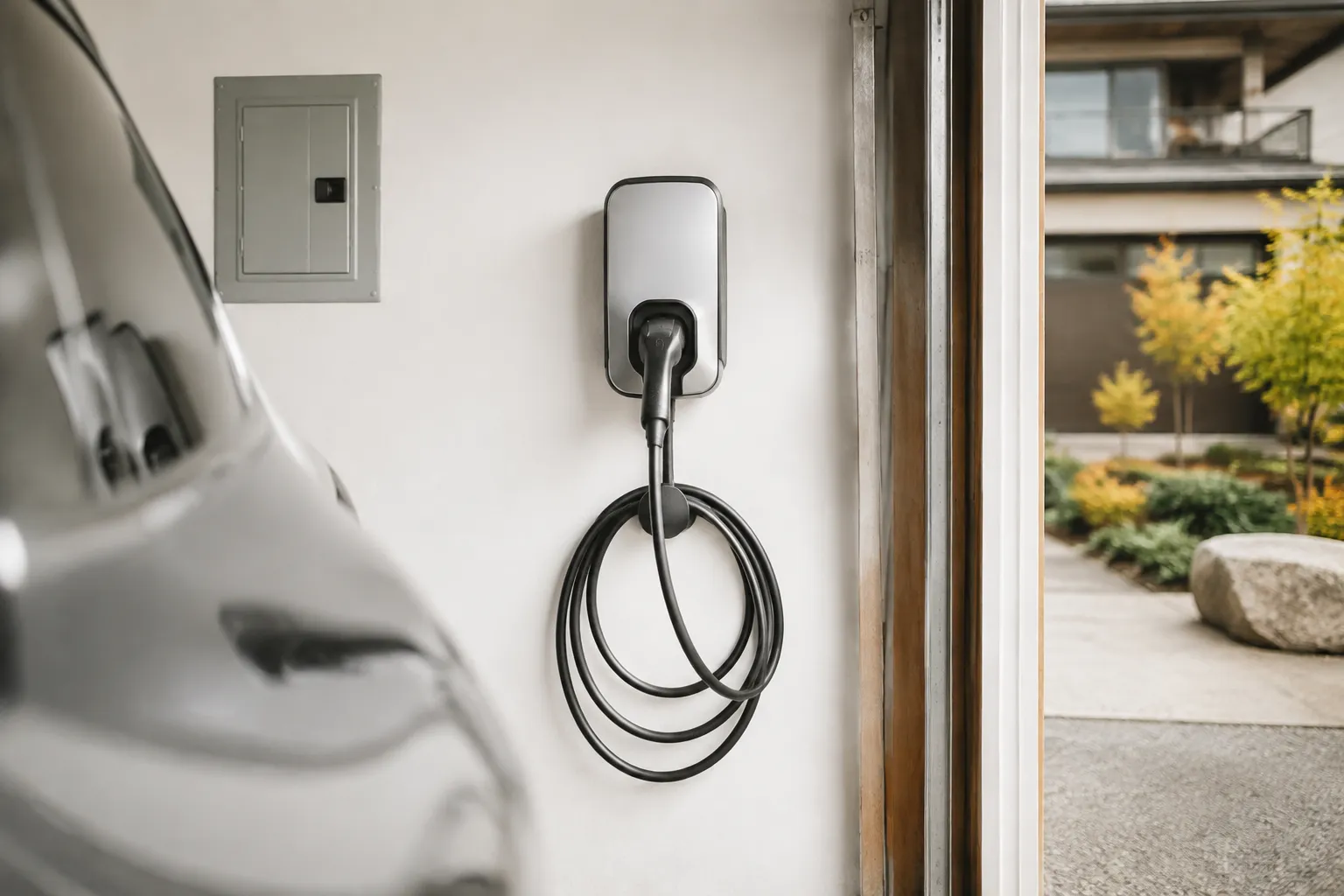
Licensed Electrical Contractor
Licensed and insured in British Columbia.
WorkSafeBC Registered
Active and in good standing.
BBB Accredited
Accredited since 2023.
Canadian family owned, working across British Columbia since 2019.
Get a quoteHow does EV charger installation work in British Columbia, and who pulls the permit?
We calculate the load before anything else, so we know your panel can carry the charger. Then we pull the electrical permit for whichever authority covers your address, run the circuit from the panel out to the charger, hook it up at both ends, and test it with you watching.
- We calculate the load first. If the panel cannot take it, you hear that here, not halfway through.
- We pull the permit before the work starts. You do no paperwork.
- We settle the route before anyone picks up a drill.
- We are there for the inspection too.
The four questions
EV charger installation cost: what changes the price
We charge $135 an hour for a Red Seal electrician plus a helper. That is two people on site, not one. Plenty of jobs go out at a flat rate instead, once we have seen the work. The consultation and the estimate are both free. Tracing a fault is the one exception, at $165 for a 45-minute diagnostic. Our Google rating is 4.7 stars across 137 reviews, which is the fairest test of whether that rate is worth paying.
The total is mostly not the charger. It is the distance and the difficulty of the run.
What actually changes the price:
- How far the charger sits from the panel. A garage on the other side of the panel wall is cheap. A detached garage at the end of the driveway is not.
- Whether the wire can follow an easy route, or has to be fished through finished walls.
- Whether your panel has room, or needs work first.
- Indoor or outdoor. A driveway spot needs gear rated to sit out all winter.
- Condo or strata parking, where the building has approvals to clear before anyone drills.
- The charger itself, if you have not bought one yet.
One Canadian EV owner summed it up on a forum as "a pretty wide range depending on panel upgrades, wiring distance, and permits." That matches what we see.
If you want a number for your own house, we will come and look at the run first.
Home EV charger installation: will your panel take a Level 2 charger?
Level 1 vs Level 2 EV charger, in plain terms: Level 1 is the cord that came with the car, plugged into an ordinary outlet, adding maybe 8 km of range an hour. Level 2 is the wall unit on its own 240-volt circuit, adding 30 to 60. A Level 2 charger installation is what this page is about.
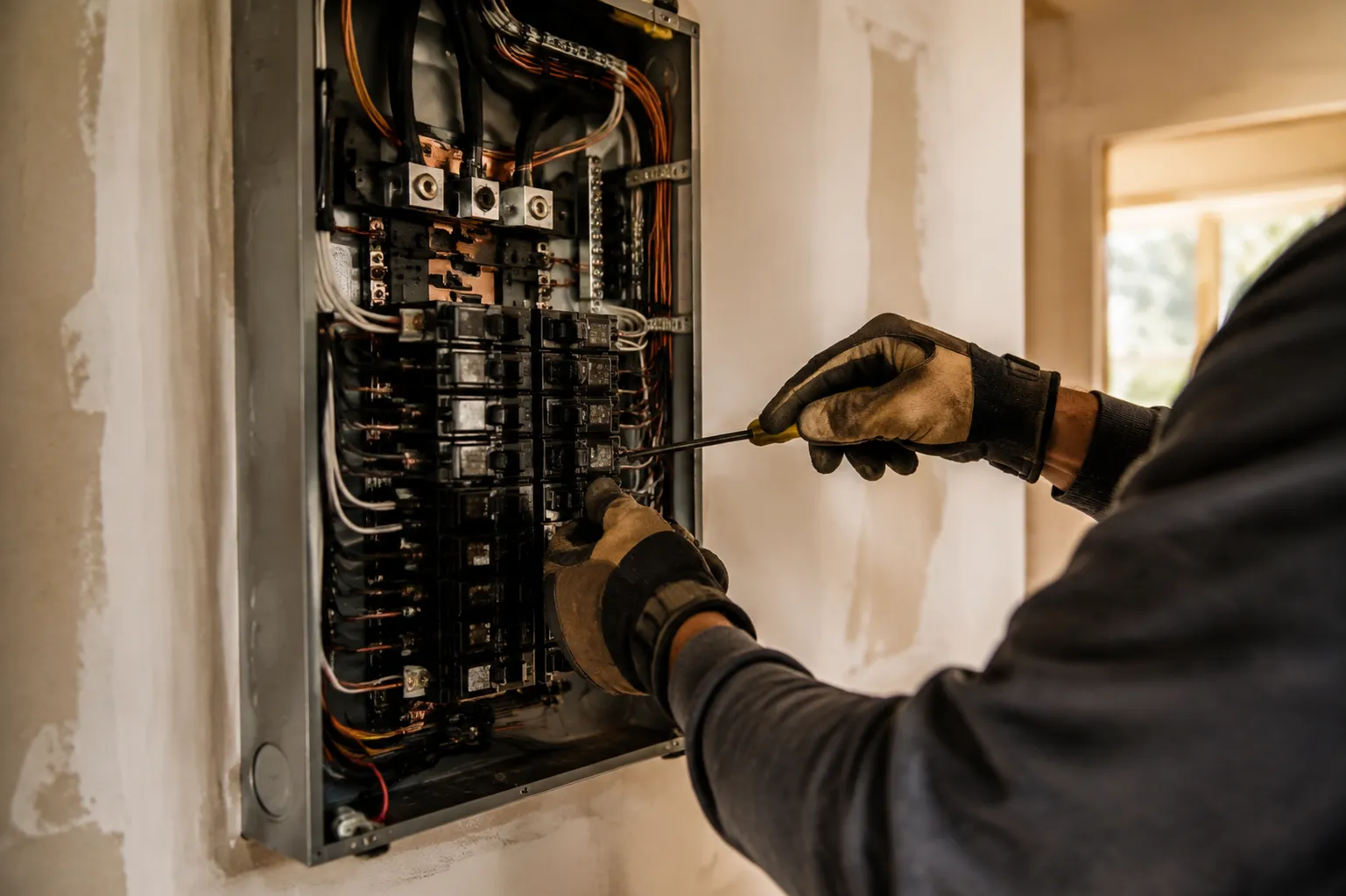
Most home Level 2 units run at 32 to 48 amps. Your panel needs a free double slot for the breaker, and your service needs headroom to carry that draw with everything else in the house running.
So what is a load calculation? We add up what the house already demands, add the charger, and compare the total against the size of your service. It is arithmetic, not opinion. The load is calculated before anything new goes on the panel, every time, on every job.
A 100 amp service can often take a Level 2 charger, though not always and not at the highest settings. A 200 amp service usually has room. Older homes are where it gets interesting, because a panel that is forty years old may not have a breaker still being made for it. A house that age can also still have the original knob and tube wiring behind its walls, which is a separate job — worth knowing about before the charger goes on, not after.
"My panel was full" is how people describe this before they know the word load. There are three ways out: turn the charger down to a lower amperage, fit a load-management device that pauses charging when the house is busy, or upgrade the service. We install Eaton, Square D and Schneider panels, so an upgrade is not a job we hand to somebody else. Either way, you hear which of the three you are looking at before you spend anything.
Do you need a permit, and who deals with the inspector?
Yes. Electrical work in British Columbia needs a permit, and an EV charger circuit is electrical work.
Homeowners keep getting different answers on this. One forum thread runs to 225 comments precisely because licensed trades keep telling people a NEMA 14-50 outlet is somehow exempt.
We pull the permit
We pull the permit ourselves, in whichever municipality the job sits in. You fill in nothing. Permits in BC run through Technical Safety BC or through your city's own electrical inspection office depending on where you live, and working out which one applies is our problem, not yours.
We are there for the inspection
We are there for the inspection too. You are not left standing in your driveway explaining someone else's wiring to an inspector.
The paperwork is also the only proof that exists. Years from now, when you sell the house, a permitted and inspected circuit is a record you can hand over. An unpermitted one is just your word.
Can you install an EV charger yourself, or do you need an EV charger installer?
You will find plenty of people online saying yes. Some of them are right about their own house and wrong about yours.
The dryer outlet question comes up constantly. A dryer plug is a 30 amp circuit shared with an appliance that already uses it. Charging through it means running at a fraction of the speed, or loading a circuit that was never sized for hours of continuous draw. Continuous is the word that matters. A dryer runs for forty minutes. A car charges for six hours.
Then there is the licensing. In BC the permit is pulled by a licensed electrical contractor, and that is a company licence, not a personal ticket. A licensed EV charger installer calculates the load first, handles the permit and the inspection for you, and carries the responsibility if something turns out to be wrong.
NEMA 14-50 vs hardwired
First, what is a NEMA 14-50 outlet? It is a heavy 240-volt receptacle, the same kind a range uses. A NEMA 14-50 outlet installation puts it on the wall and you plug the charger in. Hardwired means the charger wires straight into the circuit, no plug.
Plug-in
Plug-in is easier to swap and to take with you if you move.
Hardwired
Hardwired handles higher amperage, has one fewer connection to work loose, and is what most units want above 40 amps.
Can you install an EV charger outside? Yes, and driveway and detached-garage installs are ordinary work here. The charger, the receptacle and the enclosure all have to be rated for it, which is not the same as being tucked under an eave and hoped for. The same outdoor-rated thinking runs through the low-voltage lighting we put along paths and driveways — different voltage entirely, same BC weather.
The failure we keep finding
A common EV charger mistake: undersized wire
The most dangerous thing we find in BC homes is an EV charger installed without a Red Seal electrician, on thin wire instead of the proper heavy gauge. The wire cannot carry what the breaker lets through, so it heats up every time the car charges. Eventually it burns.
One electrician opened a customer's panel, photographed what he found, and called it a "fire waiting to happen." Another family woke to an alarm and found "the box was so hot to touch" they waited an hour before going near it. Their installer had answered a repeatedly tripping breaker by fitting a bigger breaker.
That is the whole failure in one line: put in a bigger breaker instead of finding the fault, and the wire becomes the fuse.
So an EV charger tripping breakers is a symptom, and an EV charger overheating is that same symptom further along. Neither is a nuisance to be turned up. Both mean something in that circuit is not sized for the job it is being asked to do. If that is what is happening at your house, it is a fault to trace rather than work we can scope by looking at it: quoting visible work is free, and tracing a fault is $165 for a 45-minute diagnostic.
Calculate the load, size the conductor to the breaker, terminate it properly, and test it under load before anyone drives away.
- Conductor sized to the breaker that feeds it.
- The same breaker on undersized wire. The wire heats every time the car charges.
Our EV charger installation process
- 01
We calculate the load
Before anything else. We add the charger to what your service already carries and confirm the panel can take it. If it cannot, you hear that here, not halfway through.
- 02
We pull the permit
Filed with the authority that covers your address before the work starts. You do no paperwork.
- 03
We run the wiring from the panel to the charger
This is the part that takes the time and drives the price. Wiring that has to cross a finished house usually means opening something up, and where those openings go is worth settling before anyone picks up a drill.
- 04
We hook up the panel
The breaker goes in, the conductors are terminated, and the circuit is made up at both ends.
- 05
We test it and show you it works
We do not pack up until you have watched it run. You should not have to find out later whether it works.
How long does EV charger installation take? A straightforward one is a day. The run changes that, not the charger.
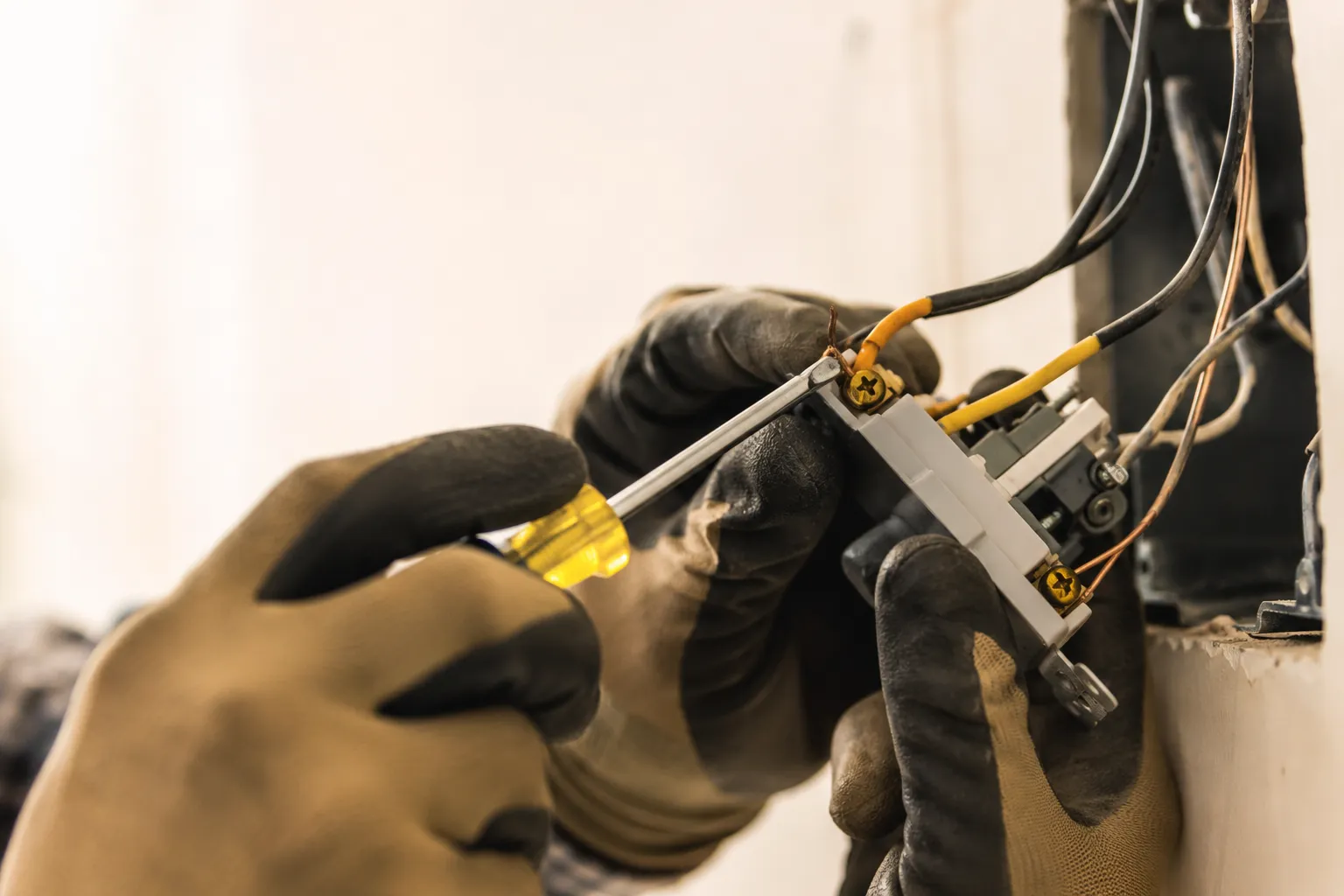
What happens if something is wrong after we leave
Four things happen on every job, before we go anywhere:
- If we find anything unexpected, we talk it through with you and get your approval before any extra work begins.
- An apprentice's work is checked by a Red Seal electrician or a Field Safety Representative, every time.
- The charger is tested before anyone packs up.
- You are shown it working before we leave.
If something is not right afterwards, you call the same number you called the first time and reach the same company.
Our guarantee terms are one year on new construction and six months on renovations.
What our customers say
Word for word from our public Google profile, typos and all.
-
I wanted to install a EV Charger for my car. I was confused between the 240v plug or the wall charger. I contacted Jas, and he recommended the $50 240v adapter. His knowledge about various wall chargers actually helped me save $650. On another note this is the only company that ever cleaned up after themselves. I highly recommend these guys.
-
Jas and His Team did an amazing job in My new to Me Home of installation of 220v power and exhaust to accommodate a dryer and solved some other electrical issues. So grateful for Their work and professionalism.
Frequently asked questions
Our EV charger installation service runs from Vancouver to Chilliwack, taking in Abbotsford, Mission and Maple Ridge along the way, and we work across the rest of the province as well. Some people call it EV charging station installation, or a Level 2 install. Same work either way: power from the panel, out to where you park. You can see the full range of electrical work we do on our services page.
The estimate is free, and a person answers the phone at any hour.
Any questions? Call 778-708-0451The Wire Guys Electrical Ltd. is a licensed electrical contractor serving Abbotsford, Vancouver, Victoria and communities across the Lower Mainland, Fraser Valley and Greater Victoria, handling residential and commercial electrical work for homeowners, landlords and business owners in British Columbia. We hold electrical contractor licence LEL0212611, and we are licensed and insured. WorkSafeBC coverage has been continuous since 30 September 2019. Canadian family owned, serving British Columbia since 2019.
How much does it cost to have an EV charger installed?
There is no single figure, and anyone quoting one sight unseen is guessing. Our labour is $135 an hour for a Red Seal electrician plus a helper, with flat rates on plenty of jobs. What moves the total is the distance from your panel, how hard the wire is to route, and whether the panel needs work first.
Do I need a permit to install an EV charger?
Yes. An EV charger circuit is electrical work, and electrical work in British Columbia needs a permit and an inspection. Depending on where you live that runs through Technical Safety BC or your municipality's own electrical inspection office. We pull the permit for whichever authority covers your address, and we attend the inspection. You do no paperwork.
Can any electrician install an EV charger?
Not quite. The permit is pulled by a licensed electrical contractor, which is a company licence rather than one person's ticket, so the firm matters as much as whoever turns up. Ask who is pulling the permit, ask whether they will be there for the inspection, and ask whether they run a load calculation before quoting.
Which EV charger should I buy?
There is no single best EV charger for home use, and we are not going to pretend otherwise. Pick the one with the features you want, at an amperage your panel can carry. What matters far more than the badge on the front is whether the circuit behind it is sized correctly. The EV charger brands we install are Tesla, Leviton, ChargePoint, Wallbox and Grizzl-E — and Grizzl-E is built in Ontario, if buying Canadian matters to you. We are not tied to any of them, so if you have already bought a unit we will put it in. You do not have to buy hardware through us.
Can I install an EV charger at home myself?
A homeowner may do electrical work in their own home in BC, but the permit and inspection still apply, and DIY work is where we see things go wrong. The wire gets undersized for the breaker, and undersized wire on a big circuit is what burns. If you do it yourself, get it permitted and inspected.
Can you do a Tesla Wall Connector installation yourself?
A Tesla Wall Connector installation is not a plug-in job. The unit is hardwired, it commonly wants a 60 amp circuit, and there is no standard plug at that size, so the conductor has to be sized and terminated correctly at both ends. The permit and the inspection apply exactly as for any other charger.
Why is my final bill higher than the electrician's quote?
Usually because something outside the agreed scope got done without a conversation first. If we open your panel and find a problem that has nothing to do with the charger, we tell you and get your approval before we touch it. Work you did not agree to is a decision you make, not a line you find on the bill afterwards.
What can go wrong with an EV charger installation?
Two things, mainly. The circuit gets undersized, so the wire overheats every time the car charges. Or the route is handled badly, and a job that should have been a few tidy openings turns into holes through half the house. Both are avoidable: the first with a load calculation and correct conductor sizing, the second by agreeing the route first.
Will an electrician leave holes in my walls?
Some opening up is usually unavoidable when a wire has to cross a finished house. What is avoidable is the scale of it and the mess left behind. Ask for the route before the work starts, and where the openings will go. Anything beyond what you agreed to, we tell you and get your approval first.
Is there a rebate for installing an EV charger in BC?
BC Hydro and CleanBC have both run rebates toward home charger installations, so check the current amounts and conditions on their own sites before you buy, because the programmes and the money available change. Keep your permit and inspection paperwork either way, as rebate programmes have asked for proof of a permitted installation before.We set out how the BC Hydro home charger rebate works, with the amounts and the application steps.
How many amps does an EV charger need?
Most home Level 2 chargers run at 32 to 48 amps, and that figure sets everything else on the circuit:
- What size breaker for EV charger circuits — usually 40 to 60 amps, sized above the charger's continuous draw.
- What gauge wire for EV charger runs — heavier than people expect, heavier again over a long run.
- Whether your panel has a free double slot for that breaker.
- Whether your service has headroom with everything else switched on.
More from us
Other electrical services we offer
Same licence on every one of them, with the permit and inspection wherever one applies.
Tell us where the charger goes. We will come and look at the run.
Have three things ready when you call: whether your panel is 100 or 200 amp, roughly how far the charger needs to run from it, and whether it is going in a garage, on a driveway, or in strata parking. That is usually enough to get you a real number.